

Social-Emotional Learning
What do I say when my child has big feelings?
Big feelings, calm brains: what to say in the storm, how to talk once it passes, and six small things to try tonight, plus ideas for preschool and early-grade teachers.
Updated

The short answer
Save the feelings talk for before and after a meltdown; in the storm, keep everyone safe, stay close (CDC) and say very little (American Academy of Pediatrics): “I’m right here. I won’t let you hit.” Once you’re both calm, name what happened (“I see that your blocks fell. Are you feeling angry?”) and look for a good solution together (CDC).
Naming a feeling isn’t an off-switch, but it may help: in one study of adults, choosing a word for the feeling on a pictured face turned down activity in a brain area that reacts to emotional faces (Lieberman et al., 2007), and in one study of Chinese preschoolers, children calmed down faster on days they labeled their own feelings more, a link rather than proof (Zhu et al., 2026).
So practice on calm days, with four starter words (happy, sad, mad, scared) (What Works Clearinghouse) and one slow breath (NCPMI). Young children borrow your calm while they build their own (ZERO TO THREE, 2025).
Key takeaways
- Big upsets are normal in early childhood (CDC). Toddlers can have tantrums every day (MedlinePlus). In one large study of 3- to 5-year-olds, about 5 in 6 had a tantrum in the past month, but fewer than 1 in 10 had them every day (Wakschlag et al., 2012).
- “Name it to tame it” comes from a parenting book (Siegel & Bryson). Researchers call it affect labeling: in one brain-scan study of adults, putting a word to the feeling on a pictured face turned down the amygdala’s response (Lieberman et al., 2007); in one study of Chinese preschoolers, children calmed down faster on days they labeled their feelings more, a link rather than proof (Zhu et al., 2026).
- Naming a feeling isn’t permission for the behavior: all feelings are acceptable, but not all behaviors are (CDC). “You’re mad. I won’t let you hit.”
- Start with four words, happy, sad, mad and scared (What Works Clearinghouse), in whichever language you’re most comfortable using (ASHA).
- Young children borrow your calm (ZERO TO THREE, 2025). If you lose yours, cool down, apologize and say what you’ll do next time: that shows your child how to recover from a mistake (American Academy of Pediatrics).
When emotions get big, children don’t need a lecture — they need a lifeline. That lifeline is mostly you: a calm grown-up nearby, a few words at the right moment, and some practice on the good days.
| Moment | Try saying | What helps |
|---|---|---|
| During the storm | “I’m right here. I won’t let you hit.” | Keep everyone safe, stay close, use very few words |
| After, once you’re both calm | “The tower fell. Were you mad? What could we try next time?” | Listen, name the feeling, plan together |
| Before the next one, on a calm day | “Smell the flower. Now blow out the pinwheel.” | Practice a few feeling words and one slow breath |
This order follows the CDC’s advice on emotion coaching (CDC). Using very few words in the storm is advice from the American Academy of Pediatrics (American Academy of Pediatrics); the starter feeling words come from the What Works Clearinghouse (What Works Clearinghouse), and the breath from the National Center for Pyramid Model Innovations (NCPMI).
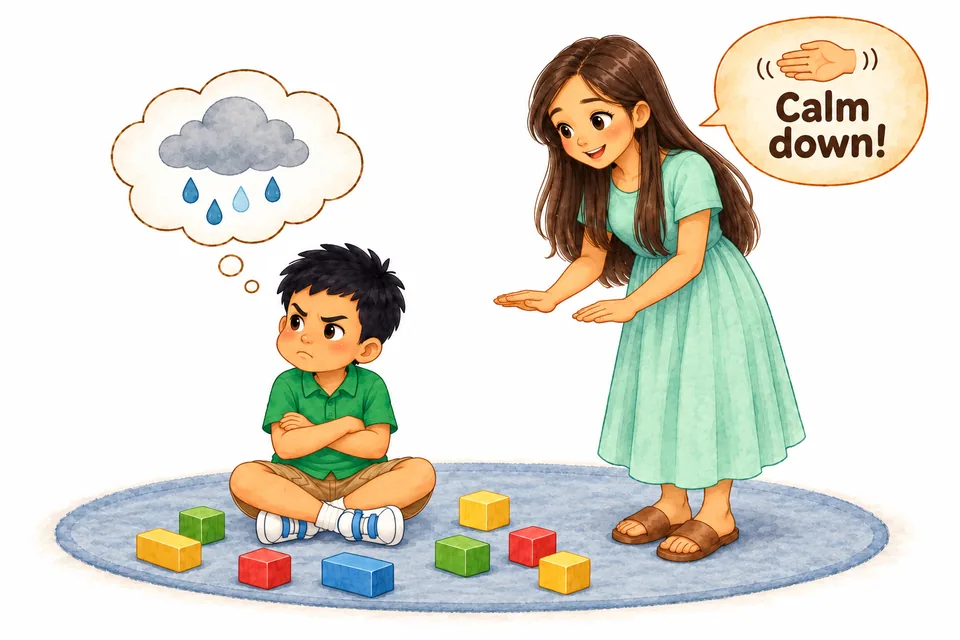
My child is melting down right now. What do I say?
 The problem
 What helps
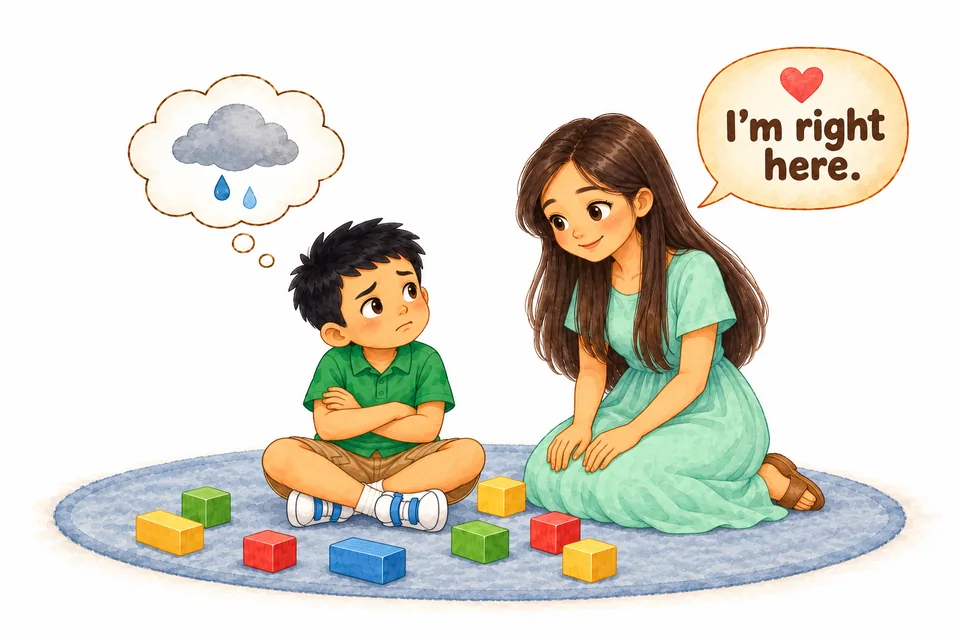
Very little. Make sure everyone is safe, then stay close, with your hands free and your eyes on your child; give them time and space, and wait until you’re both calm to talk it through (CDC). Words aren’t always needed: sitting close shows you’re paying attention (CDC).
A child in meltdown mode can’t think logically, so skip reasons and rules and hold any limit in as few words as possible (American Academy of Pediatrics). And saying “calm down” doesn’t teach calm: young children learn it when a calm adult helps them settle (ZERO TO THREE, 2025). You can’t actually make children calm down, but you can respond in ways that help them pull themselves together sooner (ZERO TO THREE, 2024).
- Stay close, or within sight. Quiet isn’t the same as ignoring: give a little space while you keep watching. “I’ll be right here by your side while you calm down.” (ZERO TO THREE, 2024)
- Stop hurting, calmly. Make room for the feeling, stop the behavior, and skip the shaming (ZERO TO THREE, 2024).
- If you name it, keep it short. “That scared you. I’m here.” (ZERO TO THREE, 2025)
Fewer words in the storm
Choose your one line now, while you’re calm, so you don’t have to find words mid-storm. Say it once, then stay close and quiet. The feelings talk comes later, once you’re both calm (CDC).
Try this tonight
Say your storm line out loud twice tonight, so it comes out on its own next time: “I’m right here. I won’t let you hit.” In Vietnamese, Mẹ ở đây với con. (“Mom is here with you.”) works too; a dad can say Ba ở đây với con.
| Instead of | Try | Why it helps |
|---|---|---|
| “Calm down!” | “I’m right here.” | Your calm helps more than the command |
| “You’re fine. Stop crying.” | “You really wanted that. It’s hard.” | Name the want before you reassure |
| “Don’t you dare hit!” | “I see that you are upset. I will stop you from hitting.” | Accept the feeling, limit the behavior |
| “Go to your room!” | “Let’s go to your calm spot together.” | An invitation, not a punishment |
| “There’s nothing to be upset about.” | “You’re disappointed we have to leave the park.” | You don’t have to agree to name it |
These swaps are adapted from ZERO TO THREE (ZERO TO THREE, 2024), the National Center for Pyramid Model Innovations (NCPMI) and the CDC (CDC).
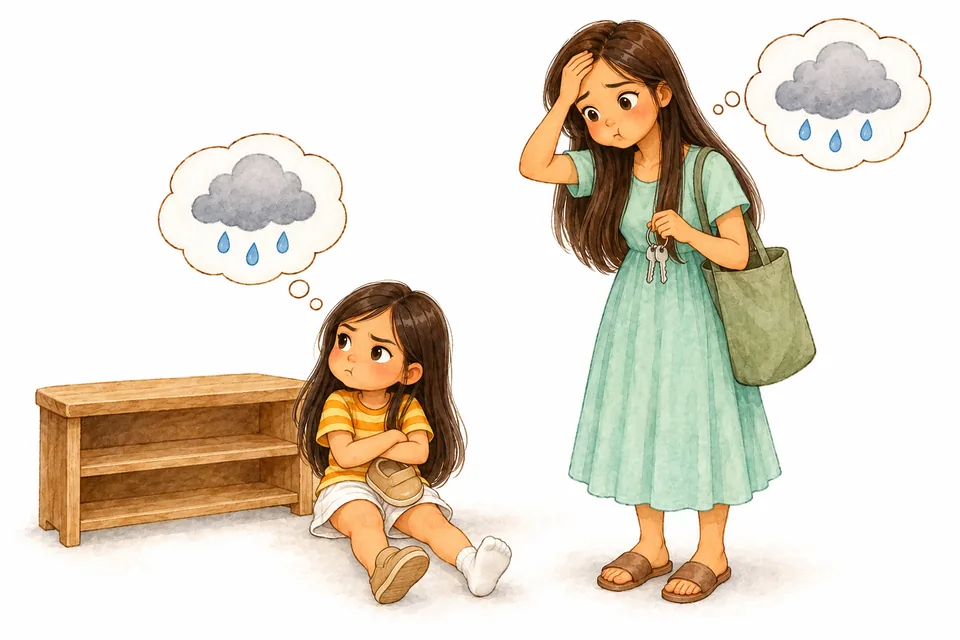
What if my child’s meltdown sets off my own?
 The problem
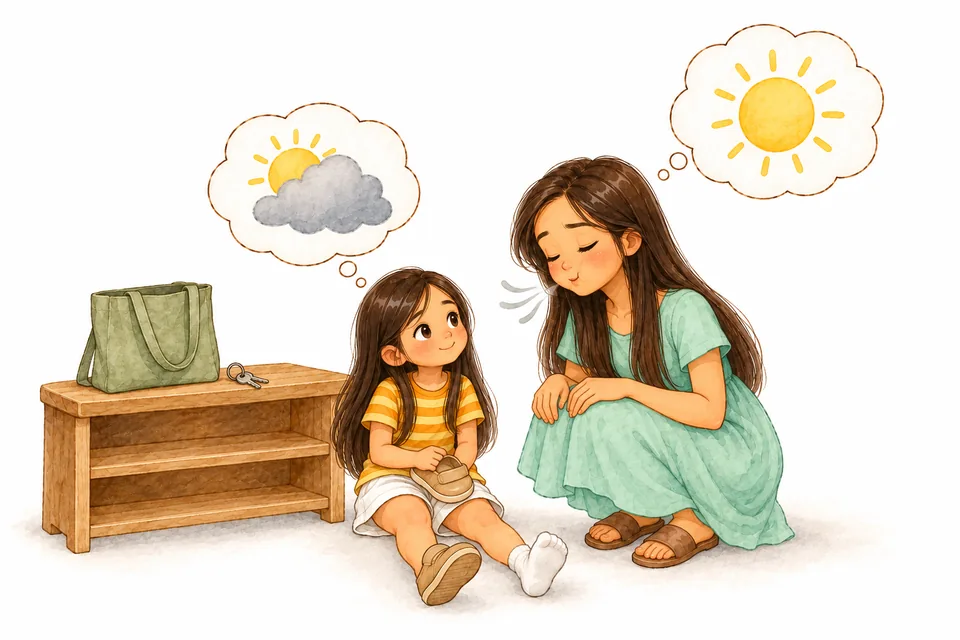 What helps
Calm yourself first (CDC). Young children borrow our calm, and ZERO TO THREE calls this co-regulation: an adult helping a child manage feelings with warm, steady support, putting comfort before correction (ZERO TO THREE, 2025).
If you snap sooner than you’d like, you’re far from alone: in a national survey of 2,200 parents of children up to age 5, 42% said they yell or raise their voice faster than they want to (ZERO TO THREE, 2016).
Calm yourself first, and repair if you slip
- Pause. Three slow breaths count, and if another trusted adult can watch your child, a longer break is fine (CDC).
- Say it out loud. “I’m frustrated. I’m going to take a deep breath.” Your child hears a feeling word and sees what you do with it (CSEFEL, Vanderbilt). Head Start’s Vietnamese handout has a similar line: Mẹ đang rất bực mình. Mẹ sẽ hít sâu. (“I’m very frustrated. I’m going to take a deep breath.”; a dad says Ba instead of Mẹ) (Head Start)
- Repair. Yelling and shaming don’t work; if you lose your temper, cool down, apologize and say how you’ll handle it next time (American Academy of Pediatrics).
Try this tonight
Choose your reset (three breaths, a glass of water, a minute in the hallway while your child is safe) and practice your repair line once: “I yelled. I’m sorry. Next time I’ll breathe first.”
The meltdown is over. What do I say now?
Now is the time for the feelings talk: sit close, listen, name the feeling in simple words, then look for a good solution together (CDC). The CDC’s own example is a block tower, like the one at the top of this page: “I see that your blocks fell. Are you feeling angry?” (CDC)
Name what your child wanted before you reassure: “You really wanted the tower to stay up.” (ZERO TO THREE, 2024) Skipping straight to “you’ll be fine” can make the upset bigger (ZERO TO THREE, 2024). The American Academy of Pediatrics describes the same order: notice, name and acknowledge the feeling, then address the need (American Academy of Pediatrics).
Give feelings a name, then a plan
- Guess, and let them correct you. “Were you mad? Or sad?” If your child says “I’m NOT mad! I’m sad!”, say their word back and add to it: “You’re sad. You worked so hard on that tower.” You don’t have to agree with a feeling to name it (CDC).
- Plan together. “Should we try stacking the blocks again?” (CDC)
- Notice the first time. Praise your child the first time they talk about a feeling instead of acting it out (CSEFEL, Vanderbilt).
Try this tonight
At bedtime, retell one hard moment from today as a tiny story with a calm ending: what happened, what your child felt (let them fill in the word) and what helped.
Which feeling words should my child learn first?
Teal speech bubbles mean Vietnamese.Orange ones mean English.
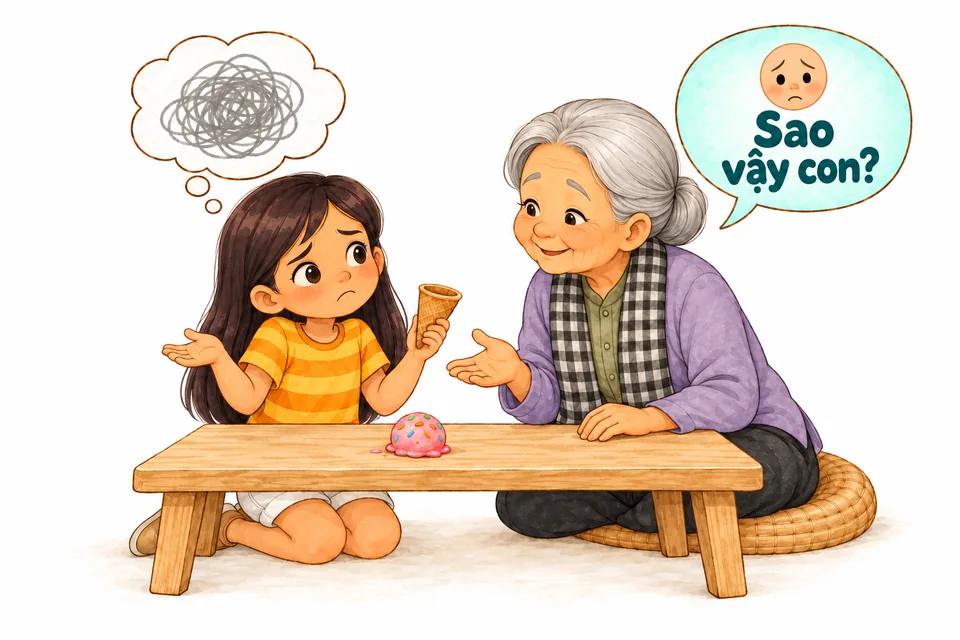 The problem
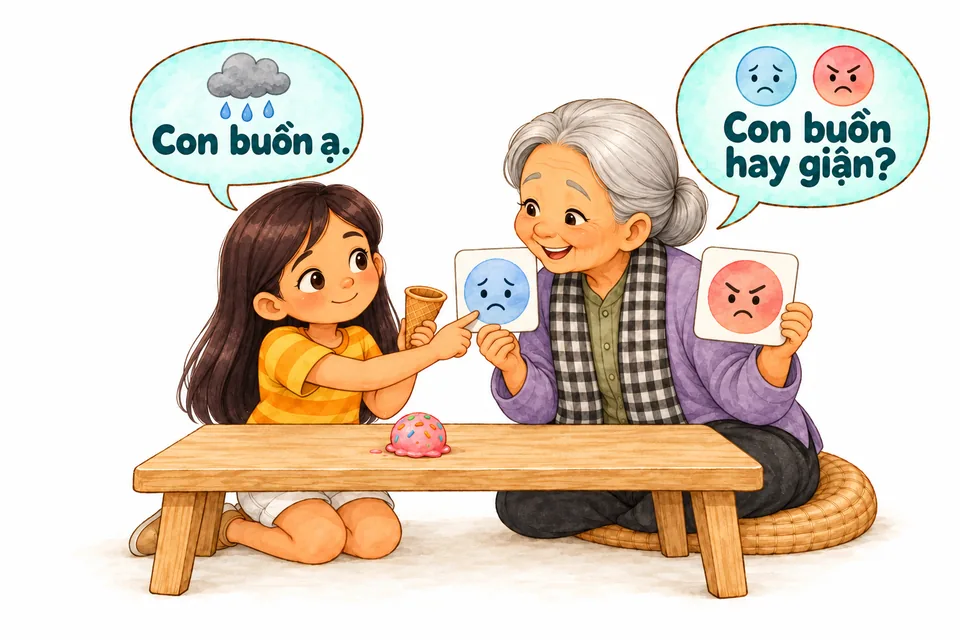 What helps
Start with four, happy, sad, mad and scared: the What Works Clearinghouse’s preschool guide suggests beginning with these basic feelings, then adding words like frustrated, excited, jealous, disappointed and tired (What Works Clearinghouse).
Young children reach for broad words first: in a German study that asked children how a story character felt, no 4- to 7-year-old said “disappointed” or “proud”, and the more often caregivers say a feeling word, the more 4- and 5-year-olds used it (Grosse et al., 2021). So keep using the bigger words yourself, tied to what just happened. Words can give children a handle on what once felt overwhelming: toddlers with stronger language skills showed less anger by age 4 (Roben et al., 2013).
- Start here: happy (vui), sad (buồn), mad (giận), scared (sợ) (What Works Clearinghouse).
- Next: frustrated (bực mình), excited (háo hức), tired (mệt mỏi), jealous (ghen tị) (What Works Clearinghouse).
- Later: disappointed (thất vọng) and proud (tự hào) (Grosse et al., 2021).
- Good feelings too: calm (bình tĩnh) and loved (được yêu thương). The CDC suggests helping children recognize all their emotions, positive and negative (CDC).
- Where they come from: most of these words are in Head Start’s free Vietnamese feelings handout, which uses tức giận for angry (Head Start).
Ask, don’t just tell, at story time
In two studies of toddlers, parents who often asked their child to name a book character’s feeling and say why had children who helped and shared more; the link was with the asking, not with parents naming feelings themselves (Brownell et al., 2013). Stop on a page and ask, “What do you think he is feeling?” and “Why is he feeling that way?” (CSEFEL, Vanderbilt) For a whole read-aloud routine in Vietnamese and English, see our bilingual reading activity kit.
Want a story made for this? In Kimly’s picture book Captain Cortex and the Big Feelings Storm, a feelings storm builds, an alarm rings, and the characters pause, breathe and get steady again. Read it on a calm day and ask how the characters feel.
Try this tonight
Open any picture book and ask, “How do you think she feels? Why?” If your child is stuck, offer two words, as the grandmother does in the picture: Con buồn hay giận? (“Are you sad or mad?”). Accept any answer, in either language.
How do we practice calm when nobody is upset?
Practice on ordinary, happy days, so a calming move is familiar before the next storm (NCPMI). Model it often: while preschoolers are learning deep breathing, the What Works Clearinghouse suggests preschool teachers model it two or three times a day (What Works Clearinghouse).
Make calm a skill, not a command
Give one breath a picture: smell the flower (in through your nose), then blow out the pinwheel (out through your mouth), a few times (NCPMI). When you feel your own frustration rising, take your slow breaths where your child can see, then ask if they’d like to try it with you (CDC).
Keep expectations honest. Across 66 randomized trials, mindfulness programs for young people showed small benefits, and no clear benefit at follow-up (Dunning et al., 2022). The breath is a tool you share, not a cure. And skip pillow-punching, even though some guides suggest it (ZERO TO THREE, 2024): the American Academy of Pediatrics advises against it (American Academy of Pediatrics), and across 154 studies, calming activities reduced anger while revving-up ones such as hitting a bag did not (Kjærvik & Bushman, 2024).
Try this tonight
Before bath, take turns: smell the flower, then blow out the pinwheel (pretend, or use a real pinwheel, a dandelion or bubbles), three slow times each. Do it again tomorrow.
Set up a calm-down corner together
- Small and cozy: a cushion, a soft toy or a favorite book, introduced on a calm day so your child can explore it.
- Offered, never sent: “I’m going to help you get to your calm spot so you can feel better.” It’s never a punishment or a threat.
- Early, then a check-in: suggest it as frustration builds, before a meltdown peaks, and once your child is calm, talk about what helped.
All three come from NCPMI’s calm-down tip sheet (NCPMI). A calm spot isn’t time-out; the FAQ explains the difference.
Try this tonight
Choose the spot together and let your child pick two things to keep there.
I teach preschool or the early grades. How do I teach feelings and calm in class?
Teach it on purpose, a little at a time: the What Works Clearinghouse rates teaching social-emotional skills in preschool as backed by strong evidence, and suggests 10 to 20 minutes of lessons once or twice a week, with stories, puppets and role-play to practice in between (What Works Clearinghouse). Across 63 studies, preschool programs like these improved children’s emotional skills, though higher-quality studies found smaller effects (Blewitt et al., 2018). In social-emotional learning (SEL), CASEL calls these skills self-awareness and self-management, which gives teachers and families shared words (CASEL).
- Morning check-in: children pick a feeling face as they arrive and again at the end of the day, then talk about why it changed or stayed the same (Joseph, Strain & Ostrosky).
- The Turtle Technique: recognize your feelings, stop your body, tuck inside your shell and take three deep breaths, then come out when you’re calm and think of a solution (NCPMI).
- A note home in the family’s language naming the week’s feeling words (What Works Clearinghouse).
- A story a day: Kimly’s book MindSmart Stories for Kids has 17 short stories for ages 3 to 10, each ending with questions to talk about.
Is this normal, or should I talk to our pediatrician?
For toddlers and preschoolers, big upsets are a normal part of growing up (CDC). Tantrums usually begin between 12 months and 3 years, when they can happen at least once a day; they happen less often from 3 to 5 and are rare after 5, and being tired, hungry or sick can make them worse (MedlinePlus). They’re not your fault, and they don’t make you a bad parent (MedlinePlus). In a study of 1,490 children aged 3 to 5, 83.7% had at least one tantrum in the past month, but only 8.6% had them every day (Wakschlag et al., 2012). In school-age children, tantrums are much less common; most who have an occasional one aren’t angry or sad in between, but recurrent or severe tantrums are a reason to seek help (AACAP).
When to call your child’s doctor. MedlinePlus advises asking your child’s doctor whenever tantrums are getting worse and you don’t think you can manage them, and, citing the American Academy of Pediatrics, it also lists these times to call (MedlinePlus):
- Tantrums get worse, or still happen often after age 5.
- Your child hurts themselves or others, or breaks things, during tantrums.
- Your child holds their breath during tantrums, especially to the point of fainting.
- Along with tantrums, your child has nightmares, loses toilet training, has headaches, stomachaches or anxiety, refuses to eat or go to bed, or clings to you.
- Child psychiatrists add: tantrums that put anyone in danger, get in the way of school or friendships, or are very frequent and last longer than expected for your child’s age (AACAP).
- And for you: if you can’t control your own anger or shouting, or you worry you might react with physical punishment, ask for help for yourself too (MedlinePlus).
This article offers learning support, not medical advice.
FAQ
Does naming a feeling really calm a child down?
A little, perhaps, but it’s no off-switch. The phrase “name it to tame it” comes from a parenting book (Siegel & Bryson). Researchers call it affect labeling: in a brain-scan study of adults, choosing a word for the emotion on a pictured face turned down the amygdala’s response (Lieberman et al., 2007). Among Chinese preschoolers, better labelers were rated better at emotion regulation, and children calmed down faster on days they labeled their feelings more: a link rather than proof (Zhu et al., 2026). Neither study tested a parent naming a child’s feeling (Lieberman et al., 2007) (Zhu et al., 2026). In a meltdown, say very little, one short line at most (American Academy of Pediatrics), and save the feelings talk for when you’re both calm (CDC).
What should I say instead of “calm down”?
Name what your child wanted, hold the limit and stay close: “You really wanted another cookie. The answer is still no. I’m right here.” (ZERO TO THREE, 2024) You can’t actually make a child calm down, but staying calm yourself helps them pull themselves together sooner, and skipping straight to “you’ll be fine” can make the upset bigger (ZERO TO THREE, 2024). Save the rules for later, since a child in a meltdown can’t think logically (American Academy of Pediatrics), and wait until you’re both calm to talk about feelings (CDC).
Doesn’t naming feelings reward tantrums?
No. Naming a feeling isn’t agreeing with the behavior; the CDC puts it this way: all emotions are acceptable, but not all behaviors are, so accept the feeling first and then set limits on hurtful behavior (CDC). ZERO TO THREE suggests doing both calmly (ZERO TO THREE, 2024): “I see that you are upset. I will stop you from hitting.” You can name the feeling and still keep the answer “no.”
At what age can a child control their emotions?
Gradually. Children aren’t born with self-control, only the potential to develop it: researchers group it with the executive function and self-regulation skills, which grow fast between ages 3 and 5 and keep developing through the teen years and into early adulthood (Harvard Center on the Developing Child). One early piece is impulse control: even when young children can repeat a rule, most can’t act on it until about 3½ to 4 (ZERO TO THREE, 2024). Many parents expect it sooner: in a national survey of 2,200 parents of young children, 56% thought children could resist doing something forbidden before age 3 (ZERO TO THREE, 2016).
Is a calm-down corner the same as time-out?
No. A calm-down spot is an invitation: a small, cozy place your child gets to know on a calm day and can use as frustration builds, with you checking in afterwards, and guidance from the National Center for Pyramid Model Innovations says it should never be used as a punishment (NCPMI). Time-out is a different tool: a brief, calm consequence for breaking a specific rule, about one minute per year of age (American Academy of Pediatrics). Calm spots are common advice from early-childhood groups (NCPMI) (ZERO TO THREE, 2024), but we found no rigorous trials testing them.
We speak Vietnamese at home. Which language should we use for feelings?
Whichever feels most natural, or both. ASHA advises using the language you’re most comfortable with, says mixing languages is expected, and notes that more than one language doesn’t cause speech or language delays (ASHA). Four first words: vui (happy), buồn (sad), giận (mad) and sợ (scared) (What Works Clearinghouse). Head Start publishes a free feelings handout in Vietnamese, Dạy con về cảm xúc (“Teaching your child about feelings”) (Head Start). Achieve Education’s parent guide to teaching your child Vietnamese at home has more everyday ideas.
What are good next steps for our family?
If you’d like more help at home, you could open a free homework guide tonight, share a picture book on a calm day, or email us about a free discovery call.
Is homework where the storms hit at your house?
The Homework Peace Plan
Kimly and Dr. Nakata’s free ten‑page guide offers seven simple ways to make homework time calmer, from a short reset before the work to a checklist for the fridge.
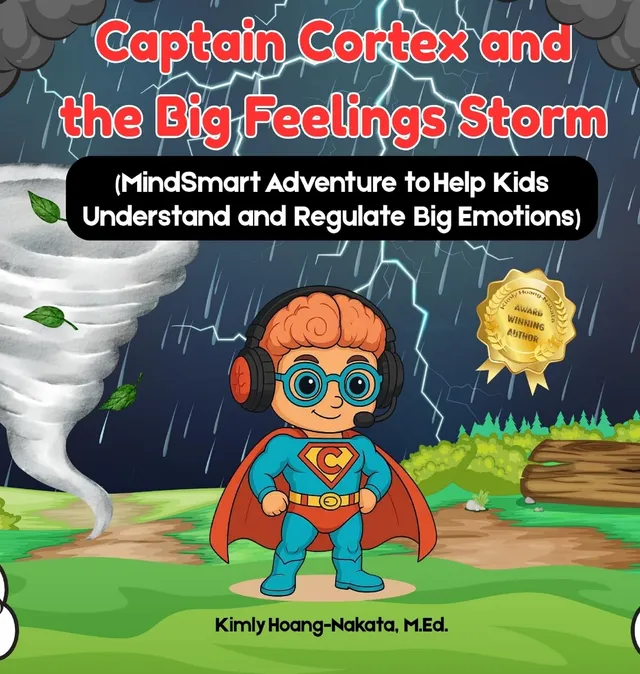
Would a story help your child practice calm before the next storm?
Captain Cortex and the Big Feelings Storm
In Kimly’s picture book for ages 3 to 10, Captain Cortex and his crew show children how to pause and take a slow breath when a feelings storm builds.

Would it help to talk through what’s happening at your house?
A free discovery call with Kimly
Email us about what learning looks like at your house, and Kimly will listen and suggest clear next steps.
Sources
All links were checked in October 2026.
- CDC. Tips for Noticing and Naming Emotions. Essentials for Parenting Toddlers and Preschoolers (updated April 30, 2026). https://www.cdc.gov/parenting-toddlers/noticing-and-naming/emotion-coaching.html Tantrums are normal at this age; safety and closeness first; coach once both are calm; all emotions acceptable, not all behaviors; the parent’s pause.
- Lieberman, M. D., Eisenberger, N. I., Crockett, M. J., Tom, S. M., Pfeifer, J. H., & Way, B. M. (2007). Putting feelings into words: Affect labeling disrupts amygdala activity in response to affective stimuli. Psychological Science, 18(5), 421–428. https://www.uclascnlab.com/s/Lieberman_Psychological-Science2007.pdf 30 adults: choosing an emotion word for a pictured face turned down the amygdala’s response.
- Zhu, C., Ip, K. I., Liu, Z., & Yan, N. (2026). Labeling it makes you feel better: The role of affect labeling on emotion regulation among Chinese preschoolers. Child Development, 97(2), 451–464. https://pubmed.ncbi.nlm.nih.gov/41718720/ 334 preschoolers: better labelers, better-rated regulation; in a 14-day diary (181 children), faster calming on high-labeling days.
- What Works Clearinghouse (2022). Preparing Young Children for School (WWC 2022009), Recommendation 1. Institute of Education Sciences. https://ies.ed.gov/ncee/WWC/Docs/PracticeGuide/TO4_PRACTICE_GUIDE_Preparing-for-School_07222022_v6.pdf#page=15 Four starter feelings; strong evidence; lessons, breathing practice, notes home.
- ZERO TO THREE (2025). Your Calm Is Their Calm: Co-Regulation Strategies for Infants and Toddlers. https://www.zerotothree.org/resource/your-calm-is-their-calm-co-regulation-strategies-for-infants-and-toddlers/ “They borrow our calm”; co-regulation; not learned by being told to “calm down”; “That scared you. I’m here.”
- National Center for Pyramid Model Innovations (2020). Self-Regulation Skills: Breathing Strategies. https://challengingbehavior.org/docs/Smell-Blow.pdf “Smell the flower, blow out the pinwheel”; teach strategies when children are calm.
- American Academy of Pediatrics. Screen Time & Temper Tantrums: Helpful Tips for Parents. HealthyChildren.org (updated March 13, 2024). https://www.healthychildren.org/English/family-life/Media/Pages/screen-time-and-temper-tantrums-helpful-tips-for-parents.aspx As few words as possible; don’t suggest punching a pillow.
- ZERO TO THREE (2024). Toddler Tantrums 101: Why They Happen and What You Can Do. https://www.zerotothree.org/resource/toddler-tantrums-101-why-they-happen-and-what-you-can-do/ You can’t make a child calm down; space while you supervise; impulse control at 3½ to 4; lists pillow-punching.
- National Center for Pyramid Model Innovations. Taking a Break: Using a Calm Down Area at Home (tip sheet). https://challengingbehavior.org/docs/Calm-Down-Area_Tipsheet.pdf An invitation, never a punishment; check in afterwards.
- ZERO TO THREE (2016). Tuning In: Parents of Young Children Speak Up About What They Think, Know and Need. National Parent Survey overview (2,200 parents, surveyed October 2015). https://www.zerotothree.org/wp-content/uploads/2022/10/National-Parent-Survey-Overview.pdf The 42% and 56% figures.
- Center on the Social and Emotional Foundations for Early Learning (CSEFEL), Vanderbilt University. Teaching Your Child to: Identify and Express Emotions. https://csefel.vanderbilt.edu/documents/teaching_emotions.pdf Share your feelings; ask about book characters; practice when calm.
- Head Start (2021). Dạy con về cảm xúc (Teaching Your Child About Feelings, Vietnamese edition). https://headstart.gov/sites/default/files/pdf/spb-teaching-your-child-about-feelings-vietnamese.pdf Free Vietnamese handout: feeling words and scripts.
- American Academy of Pediatrics. What’s the Best Way to Discipline My Child? HealthyChildren.org. https://www.healthychildren.org/English/family-life/family-dynamics/communication-discipline/Pages/Disciplining-Your-Child.aspx Repair after yelling; time-out about one minute per year of age.
- Shah, P. Helping Little People Manage Big Feelings. American Academy of Pediatrics, HealthyChildren.org (updated November 7, 2024). https://www.healthychildren.org/English/family-life/family-dynamics/Pages/helping-little-people-manage-big-feelings.aspx Notice the feeling, name and acknowledge it, then address the need.
- Siegel, D. J., & Bryson, T. P. The Whole-Brain Child: Refrigerator Sheet (chapter summary on Dr. Siegel’s website). https://drdansiegel.com/wp-content/uploads/2020/10/WBC-Refrigerator-Sheet.pdf Source of “name it to tame it” and the “upstairs” and “downstairs” brain.
- Pessoa, L., & Adolphs, R. (2010). Emotion processing and the amygdala: From a “low road” to “many roads” of evaluating biological significance. Nature Reviews Neuroscience, 11(11), 773–783. https://pmc.ncbi.nlm.nih.gov/articles/PMC3025529/ Against a fast “low road” that bypasses the cortex.
- Cesario, J., Johnson, D. J., & Eisthen, H. L. (2020). Your brain is not an onion with a tiny reptile inside. Current Directions in Psychological Science, 29(3), 255–260. https://par.nsf.gov/servlets/purl/10323786 The layered “lizard brain” model has long been discredited.
- Grosse, G., Streubel, B., Gunzenhauser, C., & Saalbach, H. (2021). Let’s talk about emotions: The development of children’s emotion vocabulary from 4 to 11 years of age. Affective Science, 2(2), 150–162. https://pmc.ncbi.nlm.nih.gov/articles/PMC9382957/ Broad feeling words come first.
- Roben, C. K. P., Cole, P. M., & Armstrong, L. M. (2013). Longitudinal relations among language skills, anger expression, and regulatory strategies in early childhood. Child Development, 84(3), 891–905. https://pmc.ncbi.nlm.nih.gov/articles/PMC3620964/ 120 toddlers: stronger language, less anger by 48 months.
- Brownell, C. A., Svetlova, M., Anderson, R., Nichols, S. R., & Drummond, J. (2013). Socialization of early prosocial behavior: Parents’ talk about emotions is associated with sharing and helping in toddlers. Infancy, 18(1), 91–119. https://pmc.ncbi.nlm.nih.gov/articles/PMC3524590/ Asking toddlers about book feelings; helping and sharing.
- ASHA / Communication Health Support Association. Learning More Than One Language. https://helpingyoucommunicate.org/article/learning-more-than-one-language Use your most comfortable language; no delays from two.
- Dunning, D., et al. (2022). Do mindfulness-based programmes improve the cognitive skills, behaviour and mental health of children and adolescents? An updated meta-analysis of randomised controlled trials. Evidence-Based Mental Health, 25(3), 135–142. https://pmc.ncbi.nlm.nih.gov/articles/PMC9340039/ 66 trials: small effects, none at follow-up.
- Kjærvik, S. L., & Bushman, B. J. (2024). A meta-analytic review of anger management activities that increase or decrease arousal: What fuels or douses rage? Clinical Psychology Review, 109, 102414. https://doi.org/10.1016/j.cpr.2024.102414 154 studies: calming beats venting.
- Blewitt, C., et al. (2018). Social and emotional learning associated with universal curriculum-based interventions in early childhood education and care centers: A systematic review and meta-analysis. JAMA Network Open, 1(8), e185727. https://pmc.ncbi.nlm.nih.gov/articles/PMC6324369/ 63 studies of preschool programs; smaller effects in better studies.
- CASEL. What Is SEL? https://casel.org/what-is-sel/ Self-awareness and self-management, two of CASEL’s five areas.
- Joseph, G., Strain, P., & Ostrosky, M. M. Fostering Emotional Literacy in Young Children: Labeling Emotions. CSEFEL What Works Brief #21. https://csefel.vanderbilt.edu/briefs/wwb21.html Feeling check-ins.
- National Center for Pyramid Model Innovations (2019). The Turtle Technique (steps). https://www.challengingbehavior.org/wp-content/uploads/2025/03/TurtleTechnique_Steps.pdf The four steps.
- MedlinePlus, U.S. National Library of Medicine. Temper tantrums (updated by Neil K. Kaneshiro, MD). https://medlineplus.gov/ency/article/001922.htm Typical ages (toddlers: at least once a day); the AAP’s when-to-call list; help for parents.
- Wakschlag, L. S., Choi, S. W., Carter, A. S., Hullsiek, H., Burns, J., McCarthy, K., Leibenluft, E., & Briggs-Gowan, M. J. (2012). Defining the developmental parameters of temper loss in early childhood: Implications for developmental psychopathology. Journal of Child Psychology and Psychiatry, 53(11), 1099–1108. https://pmc.ncbi.nlm.nih.gov/articles/PMC3633202/ 1,490 children aged 3 to 5: 83.7% had a tantrum in the past month, 8.6% had them daily.
- American Academy of Child & Adolescent Psychiatry (2025). Temper Tantrums. Facts for Families No. 136. https://www.aacap.org/AACAP/Families_and_Youth/Facts_for_Families/FFF-Guide/Temper_Tantrums-136.aspx School-age norms; when to seek help.
- National Institute of Mental Health. Children and Mental Health: Is This Just a Stage? https://www.nimh.nih.gov/health/publications/children-and-mental-health Unsafe behavior: seek help immediately; 988 and 911.
- Center on the Developing Child, Harvard University. InBrief: Executive Function: Skills for Life and Learning. https://developingchild.harvard.edu/wp-content/uploads/2024/10/InBrief-Executive-Function-Skills-for-Life-and-Learning-2.pdf Not inborn; ages 3 to 5 a window of dramatic growth.
How we made this: We updated this post in October 2026 with the help of AI tools for research, drafting and the illustrations, drawing on the published sources listed above. It offers learning support, not medical advice.