


Learning & Study Skills
How can I help my child study without burning out?
For parents of teens in 9th through 12th grade: why staying up late backfires, how much sleep teens really need, and seven small changes to start tonight.
Updated
The short answer
Help your teen get more from each study hour, and keep those hours out of sleep time. When a high schooler studies for hours and still feels drained, adding hours taken from sleep tends to backfire the next day (Gillen-O’Neel et al., 2013). Better study methods (Dunlosky et al., 2013) and protected sleep (Gillen-O’Neel et al., 2013) are better bets, and teens who get enough sleep and exercise report less burnout (Common Sense Media, 2024). Planned breaks may help, too (Biwer et al., 2023). Your part is to ask about the plan, not to do the work (Hill & Tyson, 2009).
Protect sleep first. Teens 13 to 18 need 8 to 10 hours per 24 hours on a regular basis, a range the American Academy of Pediatrics endorses (Paruthi et al., 2016). That is the nightly need going forward (Paruthi et al., 2016), and it doesn’t cover sleep already lost: a teen who has built up a sleep debt may need more sleep than usual for a while, and one or two long nights don’t fully repay it (AAP, Owens, 2014) (Lo et al., 2016). On nights high schoolers gave up sleep to study more than usual, they had more trouble in class and on tests the next day (Gillen-O’Neel et al., 2013).
“Burnout” isn’t a medical diagnosis (WHO, 2019). But sadness, exhaustion or loss of interest that lasts for weeks and gets in the way of daily life is a reason to talk with your teen’s doctor (NIMH, child and adolescent mental health).
As a physician and educator, I’ve watched brilliant students burn out — not for lack of effort, but for lack of a system. In medical school, no matter how hard I studied, I couldn’t keep up, until I realized no one had ever taught me how to learn (my story).
The students I’ve seen do well for the long haul study in a way that works with the brain instead of against it. Each of the seven strategies below ends with a “tonight” step: something to set up, ask or say with your teen. Several are study habits your teen will use, so share those, and leave the doing to them. Start with one or two that fit your family, and let your teen help choose.
Key takeaways
- Staying up later than usual to study tends to backfire the next day (Gillen-O’Neel et al., 2013). Studying isn’t the problem; losing sleep for it is (Gillen-O’Neel et al., 2013).
- In 2025, only 24% of U.S. high school students got at least 8 hours of sleep on an average school night, so about 3 in 4 got less than 8 hours, the bottom of the 8 to 10 hours teens need (CDC YRBS, 2025). Lost sleep adds up, and one or two long nights don’t fully repay it (AAP, Owens, 2014) (Lo et al., 2016). Charging phones outside the bedroom and keeping a steady wake-up time, weekends included, are easy places to start (CDC YRBS, 2025).
- Quizzing themselves after a first read, and spreading study over days, get more from each hour than re-reading (Dunlosky et al., 2013) (Pashler et al., 2007).
- Daily movement is good for health and lowers the risk of depression (CDC, physical activity benefits), but don’t count on a quick workout to sharpen focus: in teens, that boost has been small, close to none in one analysis (Erickson et al., 2019).
- In research on middle schoolers, talking about goals and plans was the parent involvement most linked with achievement (Hill & Tyson, 2009). Offer help; don’t take over.
Is my teen burned out, or just tired and behind?
 The problem
 What helps
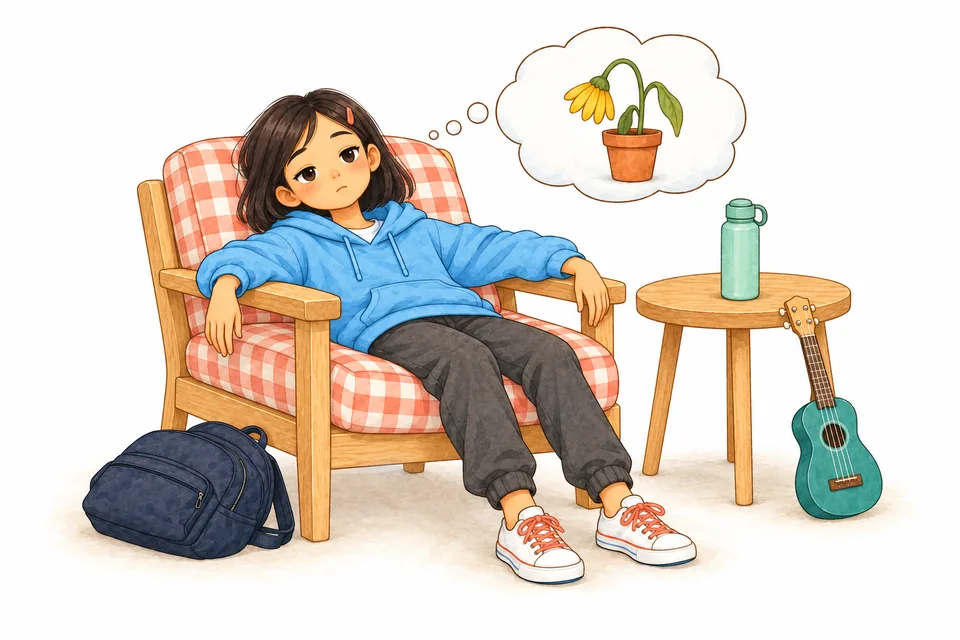
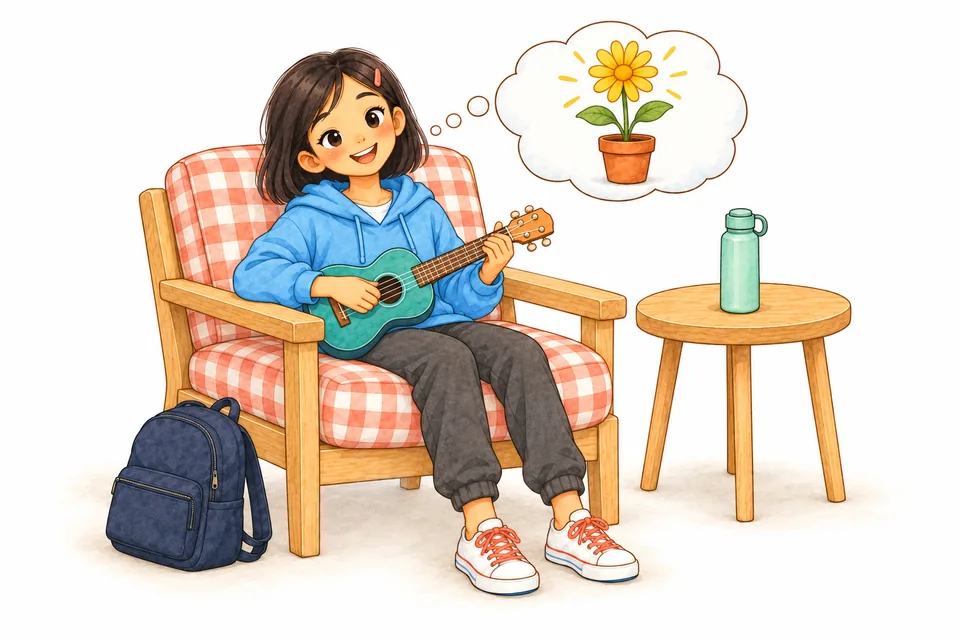
Tiredness alone doesn’t mean burnout, so watch how long it lasts. If your teen bounces back after a few good nights and a lighter week, it was probably a hard stretch. If exhaustion, low mood or loss of interest lasts for weeks and gets in the way of home, school or friends, take it seriously (NIMH, child and adolescent mental health). The World Health Organization uses “burnout” only for stress at work, not as a medical diagnosis (WHO, 2019). Researchers who study students describe “school burnout” as having three parts (Parviainen et al., 2026):
- Exhaustion from schoolwork. One item researchers use: “I often sleep badly because of matters related to my schoolwork” (Parviainen et al., 2026).
- Cynicism: losing interest in school and wondering what the point is (Parviainen et al., 2026).
- Feeling inadequate as a student (Parviainen et al., 2026).
It’s common: in a 2023 national survey, 27% of U.S. teens aged 13 to 17 said they were struggling with burnout, older teens reported more of it, and teens who got enough sleep and exercise reported less (Common Sense Media, 2024). And it can start before high school: in 673 Finnish students first surveyed at ages 12 to 13, more exhaustion over schoolwork in grades 7 and 9 predicted more depressive symptoms at 16 to 17 (Parviainen et al., 2026). That’s a link, not proof of cause (Parviainen et al., 2026), but lasting exhaustion is worth mentioning to your teen’s doctor.
It may not be laziness, either: depression can make a child act unmotivated, so others may wrongly call them lazy (CDC, anxiety and depression). A teen who used to care but now can’t start, sleeps badly and seems flat for weeks needs a conversation, and maybe a doctor, more than a lecture (NIMH, child and adolescent mental health). Here’s when to call.
Is it better to sleep or study the night before a test?
 The problem
 What helps
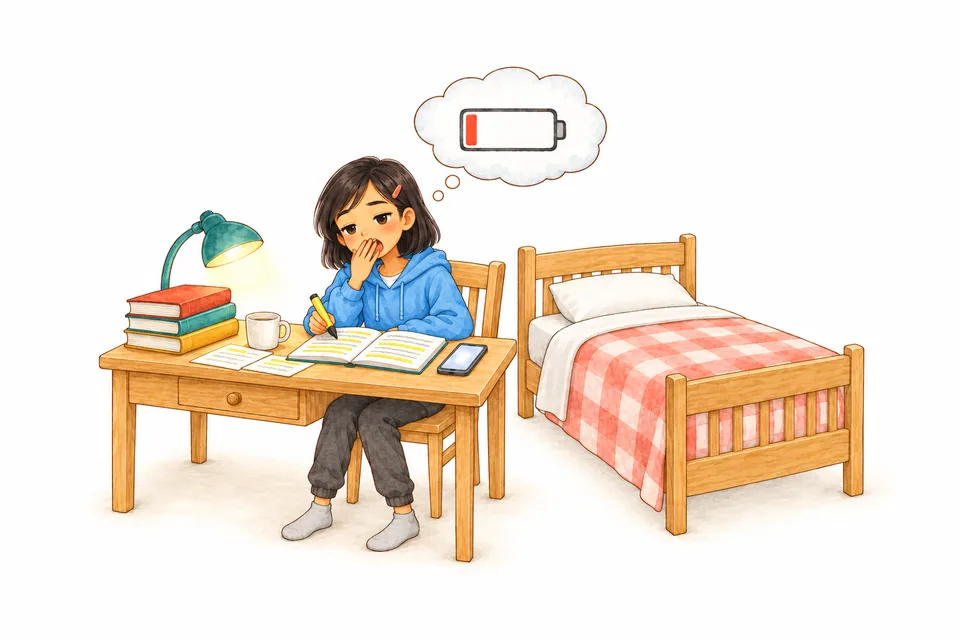
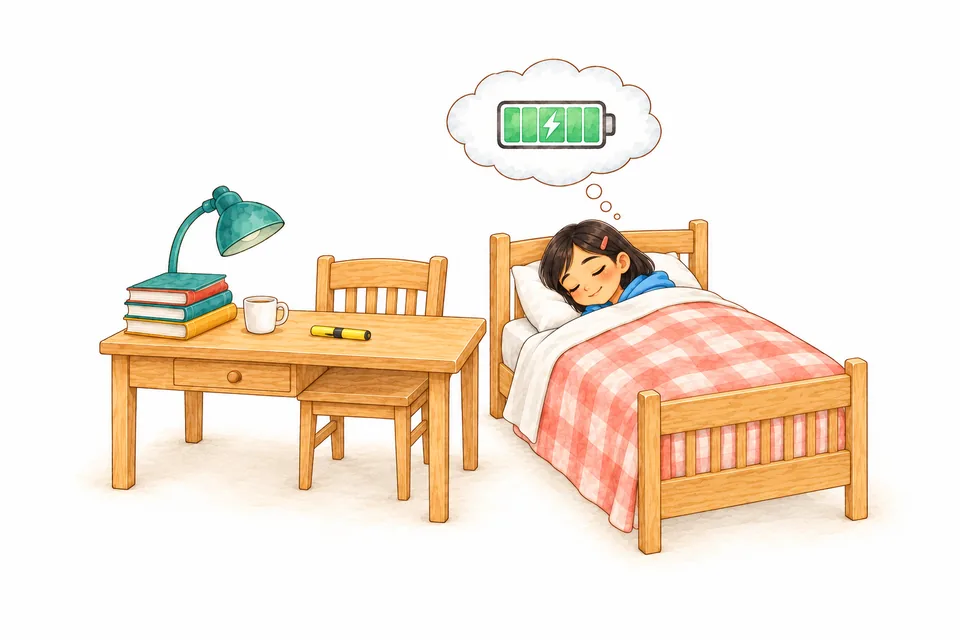
Sleep. In a UCLA study, 535 Los Angeles-area high schoolers kept 14-day diaries (Gillen-O’Neel et al., 2013). On nights they gave up sleep to study more than usual, they were more likely to struggle the next day: not understanding something in class, or doing poorly on a test, quiz or homework (Gillen-O’Neel et al., 2013). That held however much they usually studied (Gillen-O’Neel et al., 2013).
That isn’t a case for studying less: students who studied more overall still tended to get higher grades (Gillen-O’Neel et al., 2013). The researchers suggest a steady study schedule across days, using time at school well, and cutting less essential activities, not sleep (Gillen-O’Neel et al., 2013).
Spreading study out also helps when short nights happen: in an experiment with 15- to 19-year-olds, a week of 5 hours in bed a night hurt recall of crammed words, but words studied over four days held up (Huang et al., 2016).
Set a stop time, and spread the review
Agree with your teen on when studying ends before it starts, using the asleep-by time below. For a test, encourage short review sessions on different days rather than one long night (Huang et al., 2016).
Try this tonight
Late and not done? Suggest they write the one thing left on a sticky note, set the usual alarm and go to sleep. If it’s due tomorrow, a short email from your teen to the teacher beats a lost night. Test coming? Ask when the two short review sessions will go on the calendar.
How much sleep does a high schooler need, and what time should they be asleep?
Teens 13 to 18 need 8 to 10 hours of sleep per 24 hours, on a regular basis, a range the American Academy of Sleep Medicine set and the American Academy of Pediatrics endorses (Paruthi et al., 2016) (AAP, HealthyChildren). Adults need less: 7 or more hours (CDC, About Sleep). So for a teen who wakes up at 6:30 a.m., 8 hours of sleep means being asleep by 10:30 p.m. at the latest.
That range is the nightly need going forward (Paruthi et al., 2016). It doesn’t cover sleep already lost: teens who run short on school nights build up a sleep debt and often try to pay it back by sleeping in on weekends, which the AAP says gives only temporary relief and pushes the body clock even later (AAP, Owens, 2014). In an experiment, teens allowed only 5 hours in bed a night for a week slept longer than usual once they had 9 hours in bed again, yet after two of those nights their attention still hadn’t fully recovered (Lo et al., 2016). So a teen who has been running short may need more sleep than usual for a while (Lo et al., 2016). Add it with an earlier asleep-by time from the table below on most nights, keeping the same wake-up time (AAP, HealthyChildren), rather than one long lie-in.
Most high schoolers fall short: in 2025, only 24% of U.S. high school students got at least 8 hours of sleep on an average school night, so about 3 in 4 got less than 8 hours, the bottom of the 8 to 10 hours teens need (CDC YRBS, 2025). The share getting 8 hours or more fell from 31% in 9th grade to 25% in 10th and 20% in 11th and 12th (CDC YRBS, 2025). That matters for school, because sleep helps the brain form the pathways for learning and memory (NHLBI).
| Wake-up time | Asleep by, for 8 hours of sleep | Asleep by, for 9 hours of sleep | Asleep by, for 10 hours of sleep |
|---|---|---|---|
| 6:00 a.m. | 10:00 p.m. | 9:00 p.m. | 8:00 p.m. |
| 6:30 a.m. | 10:30 p.m. | 9:30 p.m. | 8:30 p.m. |
| 7:00 a.m. | 11:00 p.m. | 10:00 p.m. | 9:00 p.m. |
These times give a usual night’s sleep, with nothing extra for sleep already lost. Eight hours is the least a teen needs (Paruthi et al., 2016), and a teen who is short on sleep may need extra on top of their usual amount for a while (Lo et al., 2016).
Count back from the wake-up time
Find your teen’s wake-up time in the table and agree together on an asleep-by time at least 8 hours before it, the low end of what teens need (Paruthi et al., 2016). Aim for more if your teen still wakes up tired or has been running short lately (Lo et al., 2016). Lights out a little earlier, so they’re asleep by then.
Teens whose parents set bedtimes usually get more sleep, the CDC notes (CDC YRBS, 2025).
Try this tonight
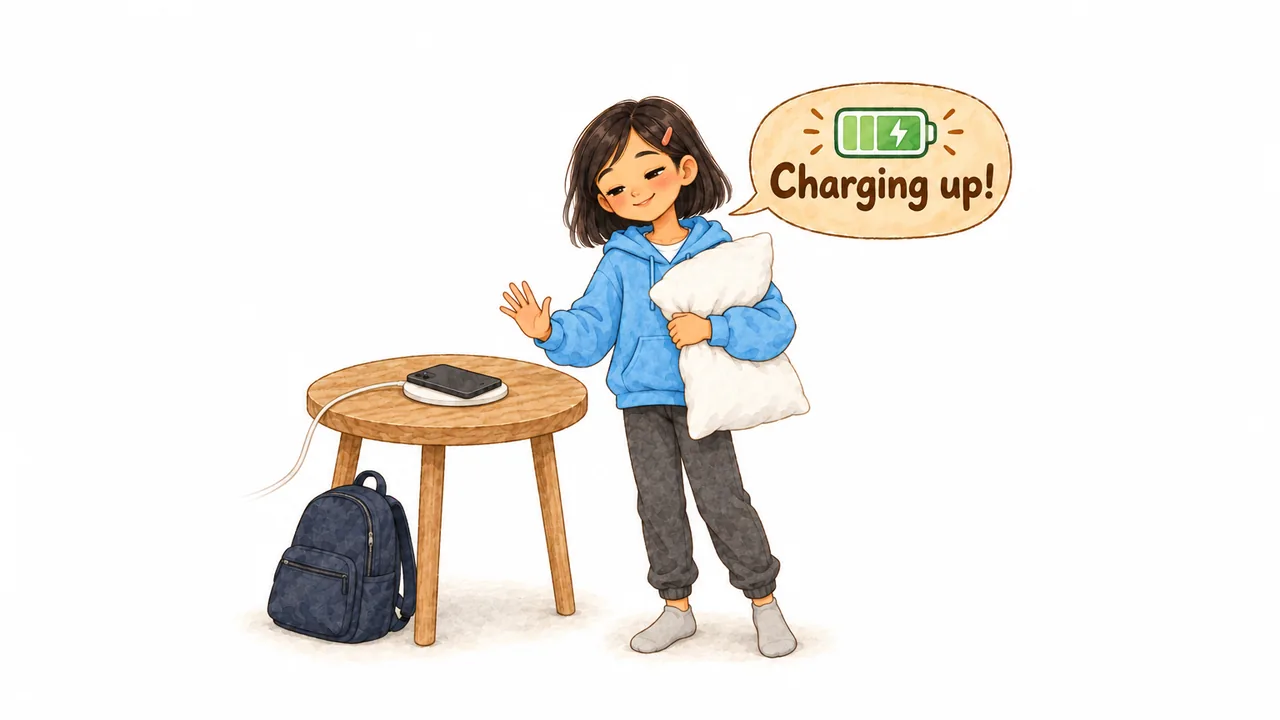
Set a family reminder an hour before lights out that means “screens off” (AAP, HealthyChildren), and ask your teen to tell you their asleep-by time.
Why can’t my teen fall asleep before 11, and what about the phone?
Partly because puberty moves the body clock: sleep–wake cycles begin to shift up to two hours later, so a high schooler who isn’t sleepy at 10 p.m. isn’t being difficult (AAP, HealthyChildren). Pushing bedtime earlier may not work on its own, because these changes make it hard for teens to fall asleep early in the evening (AAP, Owens, 2014). The AAP’s tips include the same wake-up time every day and bright light soon after waking (strategy 3), and screens off at least an hour before bed (strategy 2) (AAP, HealthyChildren).
Phones make it harder: in 20 studies of 125,198 children and teens aged 6 to 19, using a phone or tablet at bedtime was linked with too little sleep, and so was just having one in the bedroom (Carter et al., 2016). That’s a link, not proof of cause (Carter et al., 2016). The AAP advises screens off at least 60 minutes before bed and out of bedrooms (AAP, HealthyChildren); the CDC suggests storing phones outside the bedroom overnight (CDC YRBS, 2025).
Give the phone a bedtime, and keep the wake-up time steady
- Charge every phone outside the bedrooms (CDC YRBS, 2025), in one spot such as a kitchen basket, grown-ups’ phones included. Make it a house rule, not a punishment. If the phone is the alarm, a cheap alarm clock fixes that.
- Keep the same wake-up time on weekdays and weekends, and help your teen get bright light soon after waking (AAP, HealthyChildren).
Naps and caffeine are covered in the FAQ.
Try this tonight
Choose the charging spot together and put a charger there. When the “screens off” reminder goes, every phone goes to the basket.
My teen studies for hours. Why aren’t the grades moving?
Often because the hours go to popular methods that rate low: a major review of ten common study techniques rated self-quizzing and spreading study over time as the most useful, and re-reading, highlighting and summarizing low (Dunlosky et al., 2013). The U.S. Institute of Education Sciences also recommends quizzing and spacing for students in grades 3 through 12 (Pashler et al., 2007).
Read once, then close the book
Share this one with your teen. Reading helps them understand a page the first time. After that first read, they close the book and pull what they learned back out of memory, often called retrieval practice or active recall (Dunlosky et al., 2013). Here’s how I do it: I read for understanding first, then make flashcards with the information, so I’m already practicing recall.
Step by step, with a worked example: how to practice remembering what you learn.
Try this tonight
Offer to be the quizzer. After your teen reads tonight’s section once, they close the book and tell you three things they remember, then check what they missed and start tomorrow with those.
What does “learning how to learn” actually mean?
 The problem
 What helps
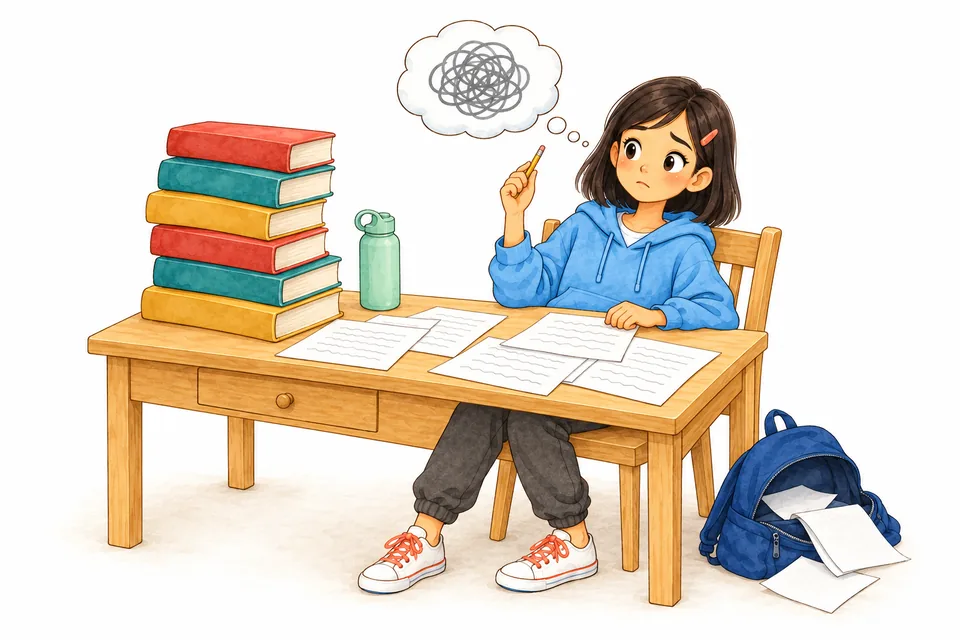
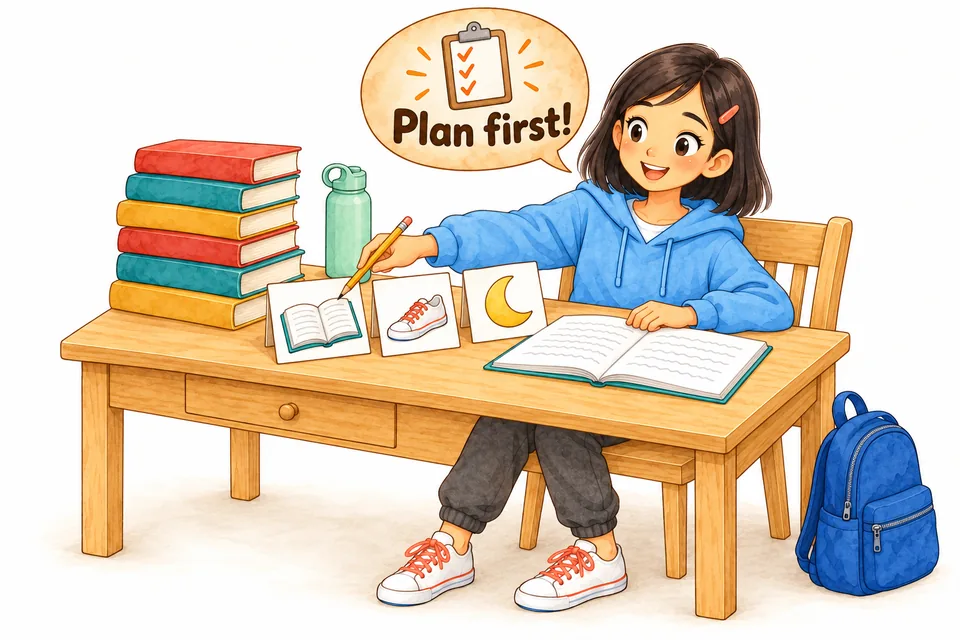
For a student, learning how to learn means getting good at running their own studying: planning the work, checking how it’s going, and looking back afterward, which researchers call metacognition (EEF, 2025). A guidance report from England’s Education Endowment Foundation found little evidence for stand-alone “learning to learn” lessons in school, since these skills often depend on the subject and the task (EEF, 2025). The report says the skill is best taught through real subject work (EEF, 2025). So the place to practice it is tonight’s real homework, which is what strategy 5 does.
Two minutes to plan, breaks planned ahead, a look back after the test
- Before your teen starts, ask what’s due, which part is hardest, and what “done” looks like tonight (EEF, 2025).
- Encourage your teen to plan breaks ahead, rather than waiting until they’re exhausted. In a study of university students, scheduled short breaks (the idea behind the Pomodoro technique) went with less fatigue and distraction than breaks taken at will, with the same work done (Biwer et al., 2023). Let your teen choose the block length.
- After a test, look back together: what went wrong, how did they study, and what will they change? Some teachers use a short form for this, called an “exam wrapper” (EEF, 2025).
Try this tonight
Ask if they’d try a two-minute plan on a sticky note: what’s due, which part is hardest (start there), when the move break is, and the stop time. Then your teen sets a timer for a block they know they can finish.
Does exercise help teens study, or does it steal study time?
 The problem
 What helps
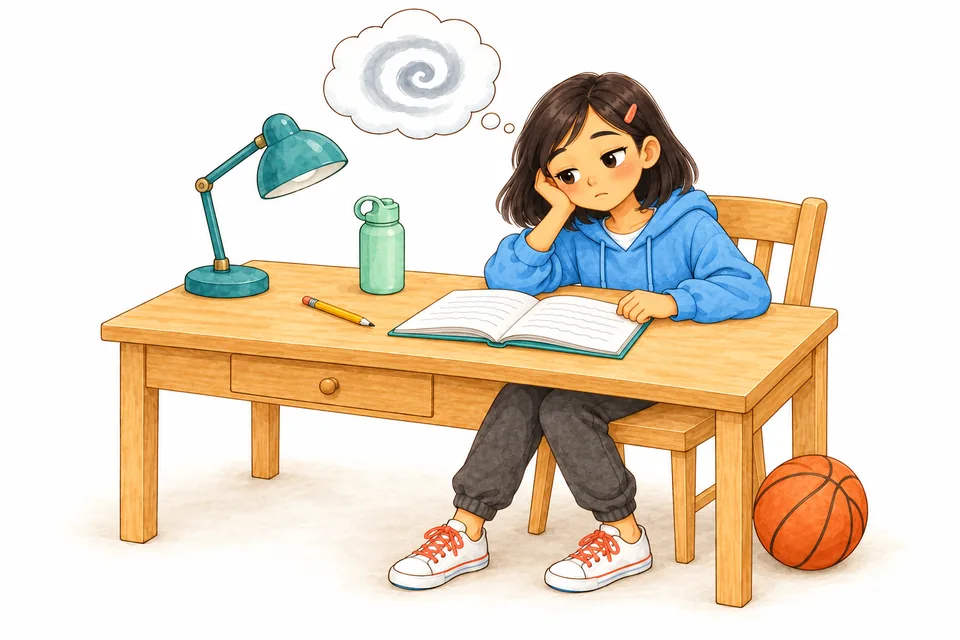
Don’t count on a quick workout to sharpen focus at this age: a single bout of moderate-to-vigorous activity gives a short-lived boost to thinking in children before their teens, but in teenagers the boost was much smaller, and for planning and self-control skills, one pooled analysis found almost none (Erickson et al., 2019).
Does the time spent moving cost teens at school? Most studies so far suggest not: in one review of studies in adolescents, 7 in 10 linked activity with better thinking or school results, 2 in 10 found no link and 1 in 10 found a negative one (Erickson et al., 2019). For ages 14 to 18, the evidence is still limited, though promising (Erickson et al., 2019).
Move anyway, for health and mood: NIMH tells teens that physical activity can help them feel better (NIMH, teen depression). The CDC recommends 60 minutes or more of moderate-to-vigorous activity a day for ages 6 to 17 (CDC activity guidelines), and lists better attention and memory and a lower risk of depression among the benefits of activity for children (CDC, physical activity benefits). Those are reasons to move most days; they don’t mean one workout will rescue tonight’s studying.
Make movement part of the day, and one of the breaks
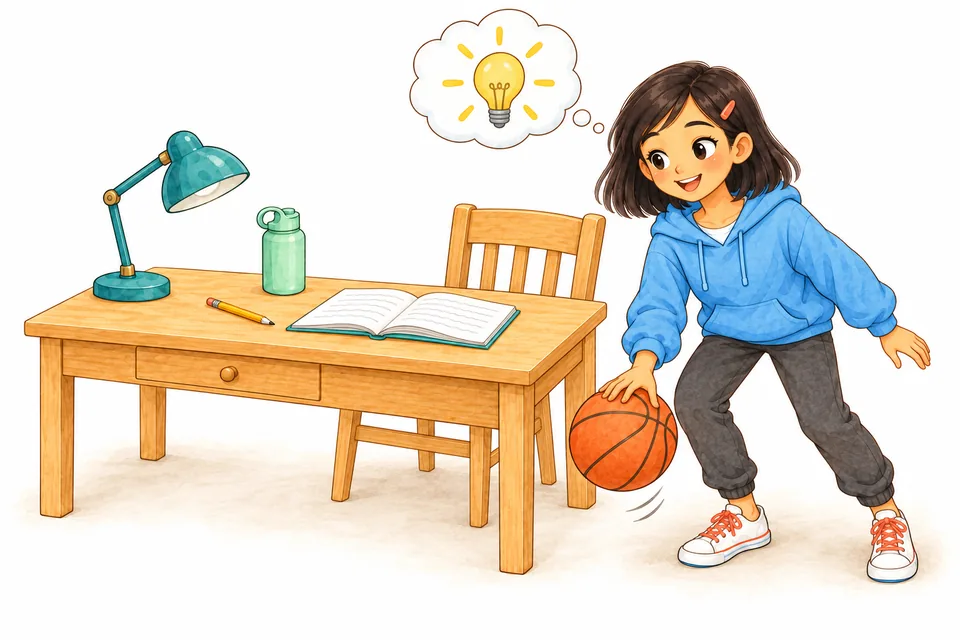
Focus isn’t only a study skill; the body sets the stage for it, and sleep is a big part of that (NHLBI). Treat movement as part of the plan rather than a reward for finishing: a walk, a bike ride or shooting hoops between school and homework, or as one of the planned breaks from strategy 5. Pitch it as a break and part of a healthy day, not a focus trick.
More ideas are in the free Five Focus Tips guide (PDF).
Try this tonight
Ask your teen when today’s movement will happen. If homework will run long, suggest making the first planned break a walk or a few shots at the hoop, then back to the same page.
How can I help without nagging or adding pressure?
Talk about goals and plans, and let your teen do the work. One large review looked at middle schoolers, a little younger than yours (Hill & Tyson, 2009). Across 50 studies, parents talking about why school matters, goals and how to study had the strongest link with achievement (Hill & Tyson, 2009). Direct homework help was the one kind of involvement linked with lower achievement, perhaps because help can turn into pressure, or because parents step in once a child is already struggling (Hill & Tyson, 2009). The authors note that this kind of talk keeps parents involved while respecting adolescents’ growing independence (Hill & Tyson, 2009).
Teens have their own advice: in advisory sessions for the 2023 Common Sense Media survey, teens asked adults to help them avoid overload, to recognize that effort is different from the outcome, and to understand how they feel rather than brush it off (Nagelhout, 2024).
| Instead of | Try |
|---|---|
| “Are you done yet?” | “What’s your plan tonight, and when do you stop?” |
| “Just push through.” | “You look fried. Move for ten minutes, then come back?” |
| “Only a B?” | “You worked hard on that. What would you change next time?” |
| “Here, I’ll do it.” | “Explain it to me like I’m in your class.” |
| “No phone tonight!” | “Let’s both park our phones at screens-off time.” |
Ask about the plan, not the grade
Look at the week together and cut something before you cut sleep, as the UCLA researchers suggest (Gillen-O’Neel et al., 2013). Offer help; don’t take over.
Try this tonight
At dinner, ask one question: “What’s the hardest thing due this week, and when will you do it?” Then offer one kind of help (quizzing, a snack or quiet company) and let your teen choose.
When is it more than stress?
When sadness, worry, exhaustion or loss of interest lasts for weeks and gets in the way of daily life (NIMH, child and adolescent mental health). The National Institute of Mental Health (NIMH) tells teens who have felt sad most of the time for a few weeks or longer to talk to a trusted adult (NIMH, teen depression). It advises parents to contact a health professional when changes last weeks or months and get in the way of home, school or friends (NIMH, child and adolescent mental health).
Ordinary stress is a reaction to something outside you, like a big test, and usually goes away once that passes; anxiety can hang on even when there’s no current threat (NIMH, stress fact sheet). NIMH’s coping list is practical: a sleep routine, exercise and regular meals, not too much caffeine, slow breathing, a journal, challenging unhelpful thoughts, and reaching out to people who help (NIMH, stress fact sheet).
This article offers learning support, not medical advice.
FAQ
Can my teen catch up on sleep on weekends?
Only partly. In a sleep experiment, teens allowed 5 hours in bed a night for a week still had weaker attention, and felt sleepier, after two nights of recovery sleep (Lo et al., 2016). The American Academy of Pediatrics notes that sleeping in on weekends brings only temporary relief and pushes a teen’s body clock later (AAP, Owens, 2014), and it advises the same wake-up time on weekdays and weekends (AAP, HealthyChildren). Aim for enough sleep every night, and know that a teen who is short on sleep may need extra for a while (Lo et al., 2016).
Is it OK for my teen to nap after school?
Keep it short and early. Sleep specialists advise teens to avoid naps after 4 p.m. and to keep after-school naps to 30 minutes or less (American Academy of Sleep Medicine, 2021). If your teen needs a long nap every day, look at how much they sleep at night, and mention it to your pediatrician.
Is coffee or an energy drink OK for late-night studying?
No. According to the American Academy of Pediatrics, medical experts advise against energy drinks for children and teens because of their sugar and caffeine, and too much caffeine can cause sleep problems (FDA, caffeine). Sleep specialists advise teens to avoid caffeine after school (American Academy of Sleep Medicine, 2021). Needing caffeine to get through the school day is a reason to look at sleep.
How much homework is too much in high school?
There’s no single number. The familiar “10 minutes per grade” guide works out to about 90 minutes a night in 9th grade and about two hours for a senior (Cooper et al., 2006). It’s a common teaching practice, and the researcher who led a major homework review said the findings are consistent with it (Cooper et al., 2006). In that review, the link between homework and achievement was much stronger in grades 7 to 12 than in elementary school, but more wasn’t always better: in upper high school, more than about two hours a night wasn’t linked with higher achievement (Cooper et al., 2006). A practical test is sleep: if homework often pushes past the bedtime your teen needs, help them tell the teachers the nightly total. Each may not know what the others assign.
What could you and your teen try next?
You could share a free guide with your teen this week, look at Dr. Nakata’s online course together, or email us about a free discovery call.
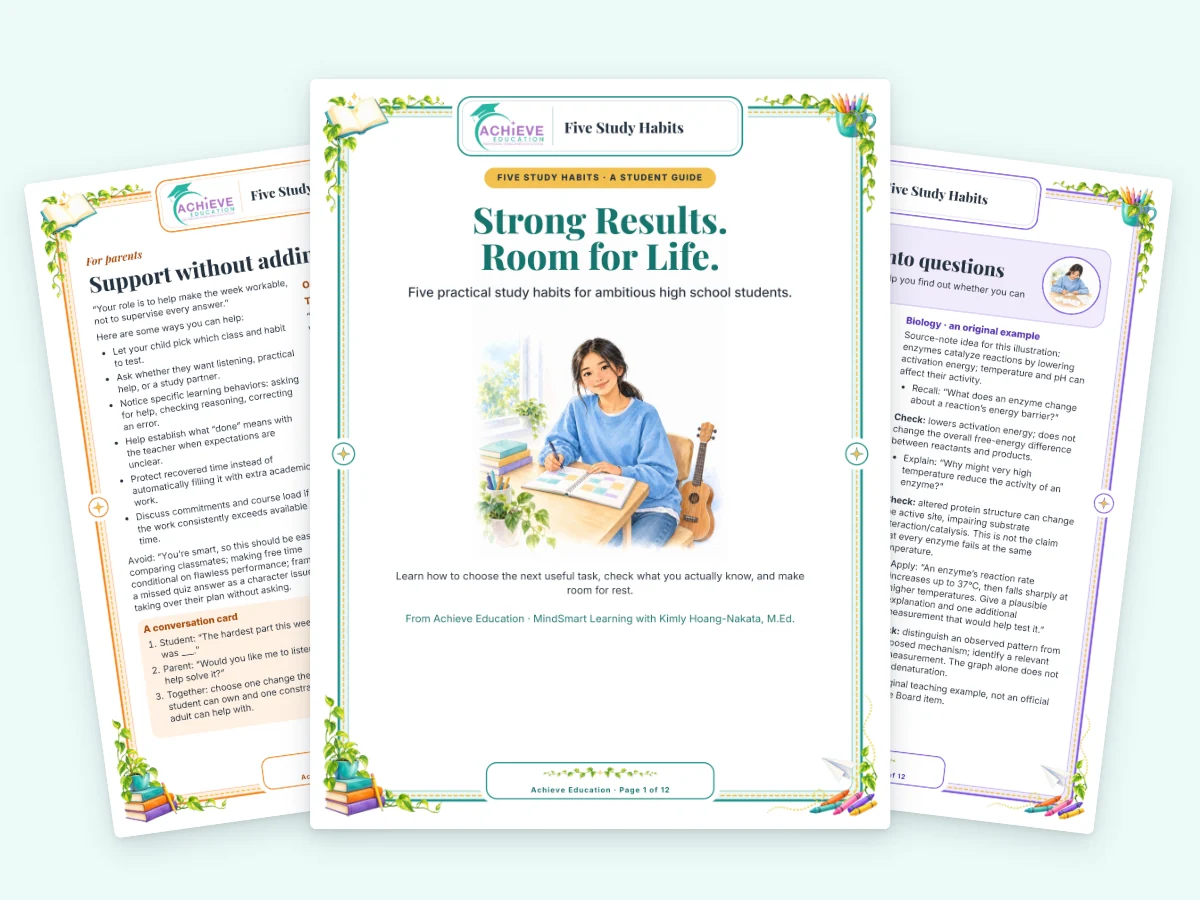
Does your teen want to do well in school and still have room to rest?
Five Study Habits
This free twelve‑page guide walks your teen through five habits, from planning the week they actually have to protecting their energy, and includes a page for parents.
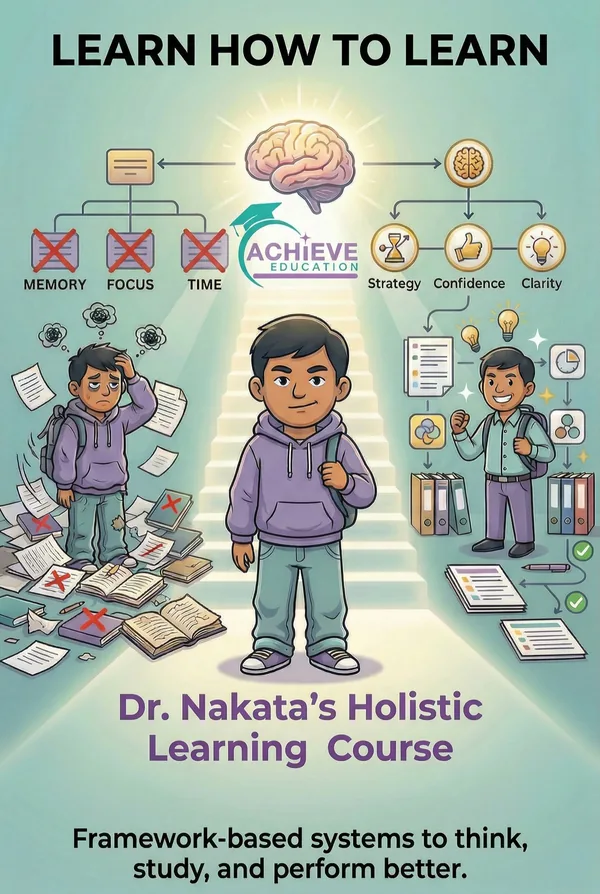
Would your teen like to try the learning system Dr. Nakata used in medical school?
Dr. Nakata’s Holistic Learning Course
Over ten days of short video lessons, this self‑paced online course covers sleep, movement and food, a daily study plan, and the motivation to restart after a setback.

Would it help to talk through your teen’s school week with someone who coaches study habits?
A free discovery call with Kimly
Tell us what a school night looks like for your teen, and Kimly will listen and help you choose what to try first.
Sources
All links were checked in October 2026.
- Paruthi, S., et al. (2016). Recommended amount of sleep for pediatric populations: A consensus statement of the American Academy of Sleep Medicine. Journal of Clinical Sleep Medicine, 12(6), 785–786. https://pmc.ncbi.nlm.nih.gov/articles/PMC4877308/ Sleep ranges by age, “on a regular basis”.
- Owens, J., Adolescent Sleep Working Group, & Committee on Adolescence, American Academy of Pediatrics (2014). Insufficient sleep in adolescents and young adults: An update on causes and consequences. Pediatrics, 134(3), e921–e932. https://pmc.ncbi.nlm.nih.gov/articles/PMC8194472/ Teen sleep debt; weekend catch-up sleep.
- Lo, J. C., et al. (2016). Cognitive performance, sleepiness, and mood in partially sleep deprived adolescents: The Need for Sleep Study. Sleep, 39(3), 687–698. https://pmc.ncbi.nlm.nih.gov/articles/PMC4763363/ Two recovery nights fell short.
- Gillen-O’Neel, C., Huynh, V. W., & Fuligni, A. J. (2013). To study or to sleep? The academic costs of extra studying at the expense of sleep. Child Development, 84(1), 133–142. UCLA Health news release. https://www.uclahealth.org/news/release/cramming-for-a-test-dont-do-it-say-ucla-researchers Sleep vs study; the researchers’ advice.
- World Health Organization (2019). Burn-out an “occupational phenomenon”: International Classification of Diseases. https://www.who.int/news/item/28-05-2019-burn-out-an-occupational-phenomenon-international-classification-of-diseases Burn-out is work-related only.
- National Institute of Mental Health. Child and adolescent mental health. https://www.nimh.nih.gov/health/topics/child-and-adolescent-mental-health When to contact a professional.
- Parviainen, M., et al. (2026; online 2025). Symptoms of school burnout in comprehensive school and mental health problems in late adolescence. Scandinavian Journal of Psychology, 67(3), 747–756. https://pmc.ncbi.nlm.nih.gov/articles/PMC13159505/ The three signs; later depressive symptoms.
- Common Sense Media, Center for Digital Thriving & Indiana University (2024). New survey shows young people are under pressure. https://www.commonsensemedia.org/press-releases/new-survey-shows-young-people-are-under-pressure 27% report burnout; older teens; self-care.
- Centers for Disease Control and Prevention. About anxiety and depression in children. https://www.cdc.gov/children-mental-health/about/about-anxiety-and-depression-in-children.html Signs of depression and anxiety.
- Huang, S., et al. (2016). Sleep restriction impairs vocabulary learning when adolescents cram for exams: The Need for Sleep Study. Sleep, 39(9), 1681–1690. https://pmc.ncbi.nlm.nih.gov/articles/PMC4989257/ Spacing protected recall.
- American Academy of Pediatrics, HealthyChildren.org. Healthy sleep habits: How many hours does your child need? https://www.healthychildren.org/English/healthy-living/sleep/Pages/Healthy-Sleep-Habits-How-Many-Hours-Does-Your-Child-Need.aspx AAP sleep advice.
- Centers for Disease Control and Prevention. About sleep. https://www.cdc.gov/sleep/about/index.html Adult sleep need.
- Centers for Disease Control and Prevention. Youth Health in Focus: Sleep (Youth Risk Behavior Survey, 2025 data; page updated August 14, 2026). https://www.cdc.gov/yrbs/youth-health-in-focus/sleep.html 24% of high schoolers got 8+ hours on school nights in 2025, by grade; phones, bedtimes, wake-up times.
- National Heart, Lung, and Blood Institute. How sleep affects your health. https://www.nhlbi.nih.gov/health/sleep-deprivation/health-effects Sleep and learning.
- Carter, B., et al. (2016). Association between portable screen-based media device access or use and sleep outcomes: A systematic review and meta-analysis. JAMA Pediatrics, 170(12), 1202–1208. https://pmc.ncbi.nlm.nih.gov/articles/PMC5380441/ Devices and sleep.
- Association for Psychological Science (2013). Which study strategies make the grade? On Dunlosky, J., et al., Psychological Science in the Public Interest, 14(1). https://www.psychologicalscience.org/news/releases/which-study-strategies-make-the-grade.html Study techniques rated.
- Pashler, H., et al. (2007). Organizing instruction and study to improve student learning. Institute of Education Sciences. https://ies.ed.gov/ncee/wwc/PracticeGuide/1 Quizzing and spacing.
- Education Endowment Foundation (2025). Metacognition and self-regulated learning: Guidance report. Updated edition of the 2018 report. https://d2tic4wvo1iusb.cloudfront.net/production/eef-guidance-reports/metacognition/metacognition-and-self-regulated-learning_guidance-report.v.2.4.0.pdf Plan, monitor, evaluate; “learning to learn” lessons; exam wrappers.
- Biwer, F., et al. (2023). Understanding effort regulation: Comparing “Pomodoro” breaks and self-regulated breaks. British Journal of Educational Psychology, 93(S2), 353–367. https://cris.maastrichtuniversity.nl/en/publications/understanding-effort-regulation-comparing-pomodoro-breaks-and-sel/ Scheduled vs self-chosen breaks.
- Erickson, K. I., et al. (2019). Physical activity, cognition, and brain outcomes: A review of the 2018 Physical Activity Guidelines. Medicine & Science in Sports & Exercise, 51(6), 1242–1251. https://pmc.ncbi.nlm.nih.gov/articles/PMC6527141/ Activity and thinking, by age.
- Centers for Disease Control and Prevention (2025). Child activity: An overview. https://www.cdc.gov/physical-activity-basics/guidelines/children.html Activity guideline.
- Centers for Disease Control and Prevention. Health benefits of physical activity for children. https://www.cdc.gov/physical-activity-basics/health-benefits/children.html Benefits of activity.
- Hill, N. E., & Tyson, D. F. (2009). Parental involvement in middle school: A meta-analytic assessment of the strategies that promote achievement. Developmental Psychology, 45(3), 740–763. https://pmc.ncbi.nlm.nih.gov/articles/PMC2782391/ Kinds of parent involvement (middle school).
- Nagelhout, R. (2024). Students are feeling burned out. Here’s how you can help. Harvard Graduate School of Education. https://www.gse.harvard.edu/ideas/usable-knowledge/24/11/students-are-feeling-burned-out-heres-how-you-can-help What teens ask of adults.
- National Institute of Mental Health. Teen depression: More than just moodiness. https://www.nimh.nih.gov/health/publications/teen-depression Signs of depression; exercise; 988.
- National Institute of Mental Health. I’m so stressed out! Fact sheet. https://www.nimh.nih.gov/health/publications/so-stressed-out-fact-sheet Stress vs anxiety; coping.
- National Institute of Mental Health. Warning signs of suicide. https://www.nimh.nih.gov/health/publications/warning-signs-of-suicide Warning signs; 988.
- Substance Abuse and Mental Health Services Administration. 988 frequently asked questions. https://www.samhsa.gov/mental-health/988/faqs When to call 911.
- American Academy of Sleep Medicine (2021). New video explains the science behind sleepy teens. https://aasm.org/new-video-explains-the-science-behind-sleepy-teens/ Naps and caffeine.
- U.S. Food and Drug Administration. Spilling the beans: How much caffeine is too much? https://www.fda.gov/consumers/consumer-updates/spilling-beans-how-much-caffeine-too-much Energy drinks and kids.
- Duke Today (2006). Duke study: Homework helps students succeed in school, as long as there isn’t too much. On Cooper, H., Robinson, J. C., & Patall, E. A., Review of Educational Research, 76(1). https://today.duke.edu/2006/03/homework.html Homework amounts by grade.
How we made this: First published in April 2026 under the byline of Roger Nakata, D.O. We updated it in October 2026 with the help of AI tools for research, drafting and the illustrations, drawing on the published sources listed above. It offers learning support, not medical advice.