


Bilingual Parenting
How can I help my child speak Vietnamese at home?
Straight answers to what parents ask most, from “they understand but answer in English” to “my own Vietnamese is shaky,” with eight strategies you can start tonight.
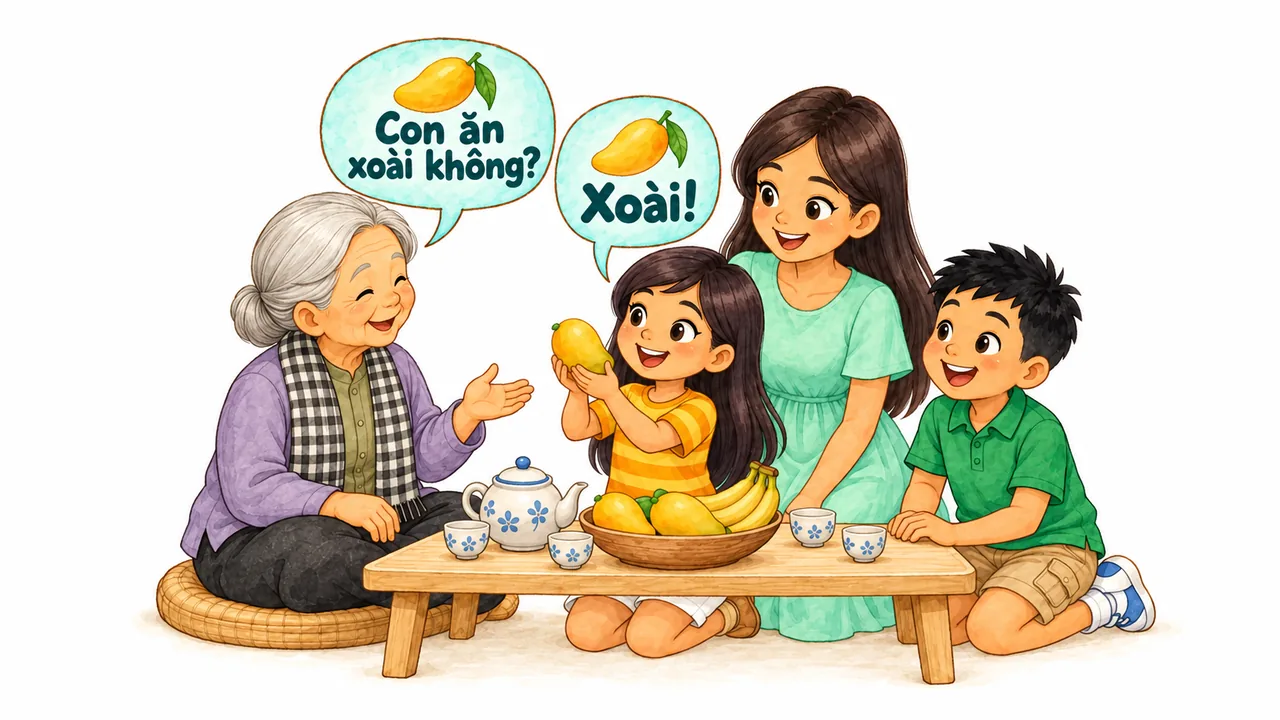
The short answer
Give Vietnamese a small, steady place in everyday life, and give your child reasons to speak it, not just hear it.
Children use a home language when they hear it often, from several fluent speakers, and get real chances to talk.
You don’t need to be fluent. Your job is the routine and the warmth: a safe space to practice. Apps, teachers and relatives can supply the native voice.
Key takeaways
- Understanding Vietnamese but answering in English is common. It usually means English has become the easier language, not that Vietnamese is gone.
- Hearing isn’t enough. Children grow the words they can say by saying them, so let them have a chance to talk.
- More Vietnamese speakers in a child’s life is linked with stronger Vietnamese.
- A few minutes every day helps words stick better than one long weekly session. It adds to real conversation; it doesn’t replace it.
- Speaking Vietnamese at home does not hold back English or cause speech delay.
My child understands Vietnamese but answers in English. Is that normal?
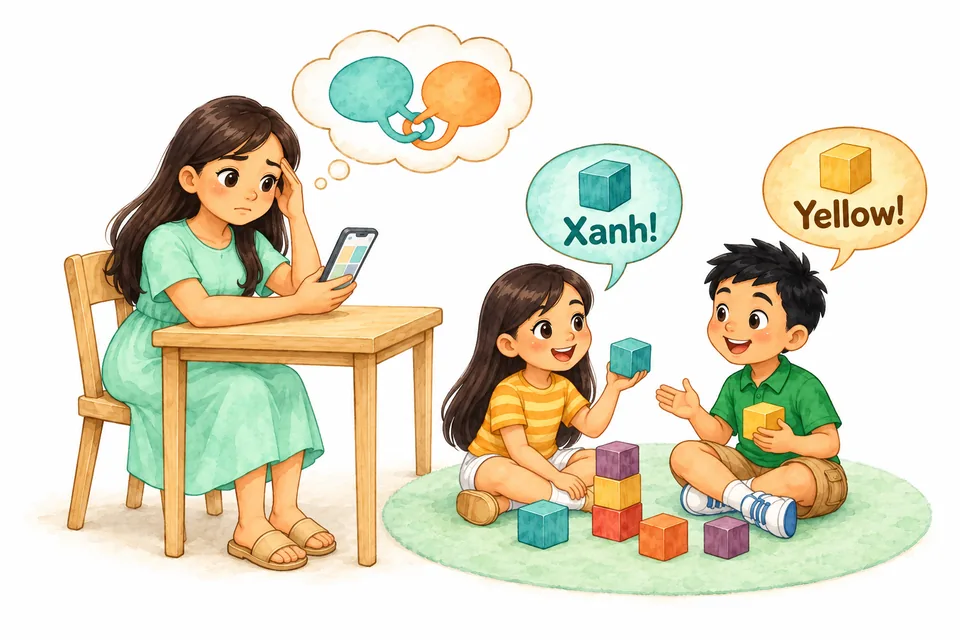
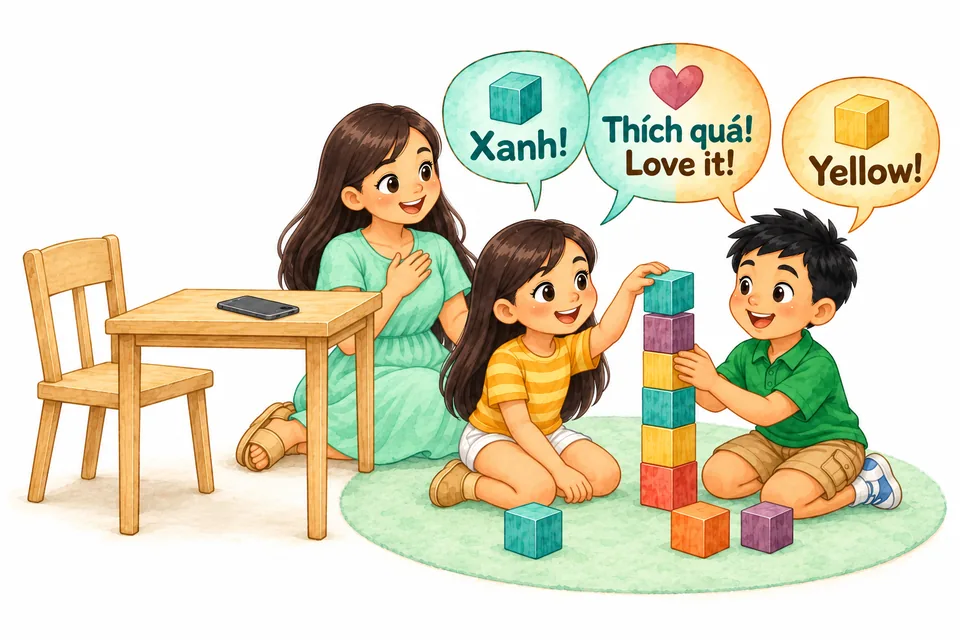
Teal speech bubbles mean Vietnamese.Orange ones mean English.
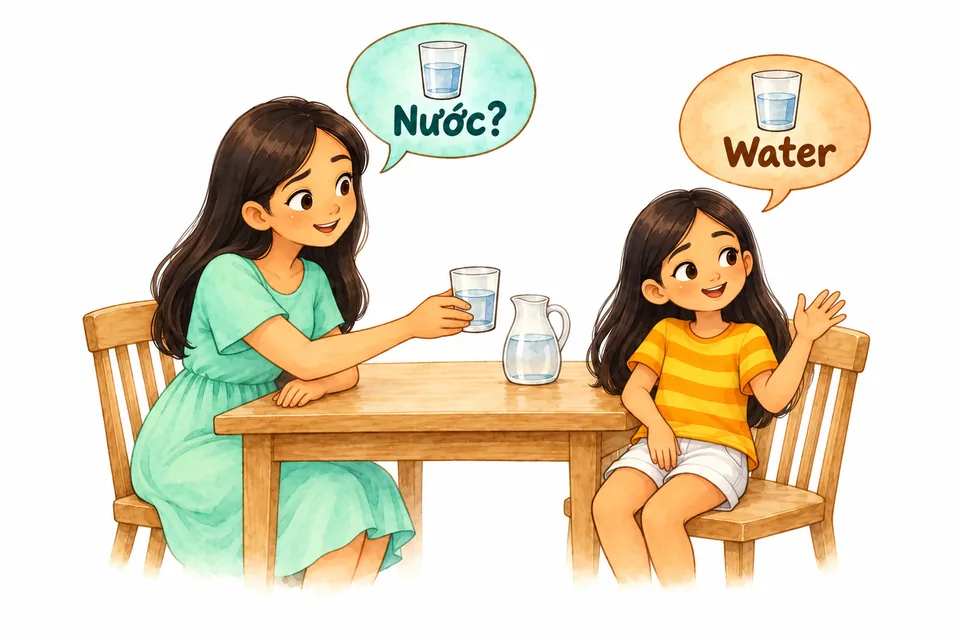 The problem
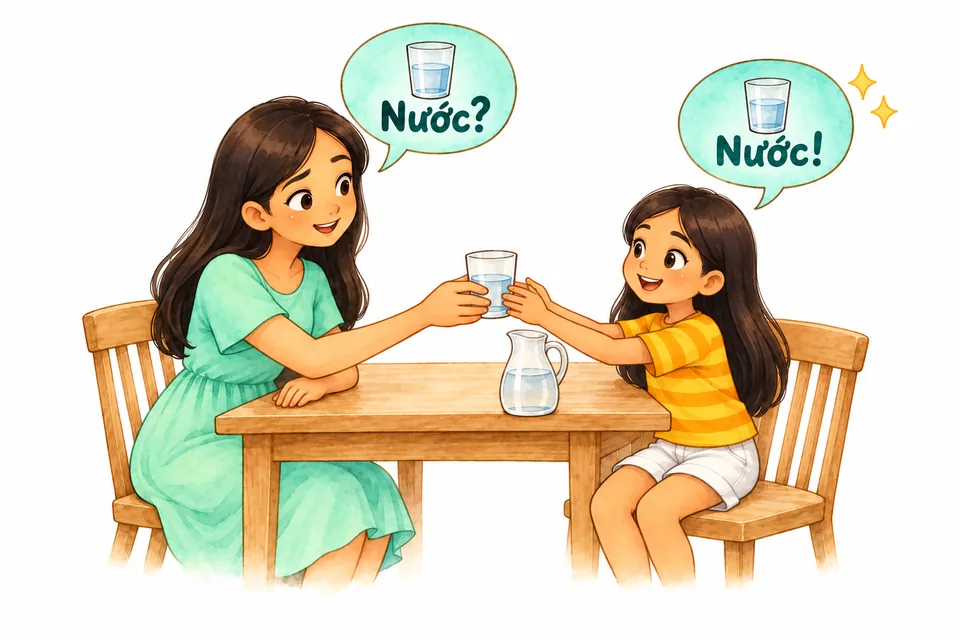 What helps
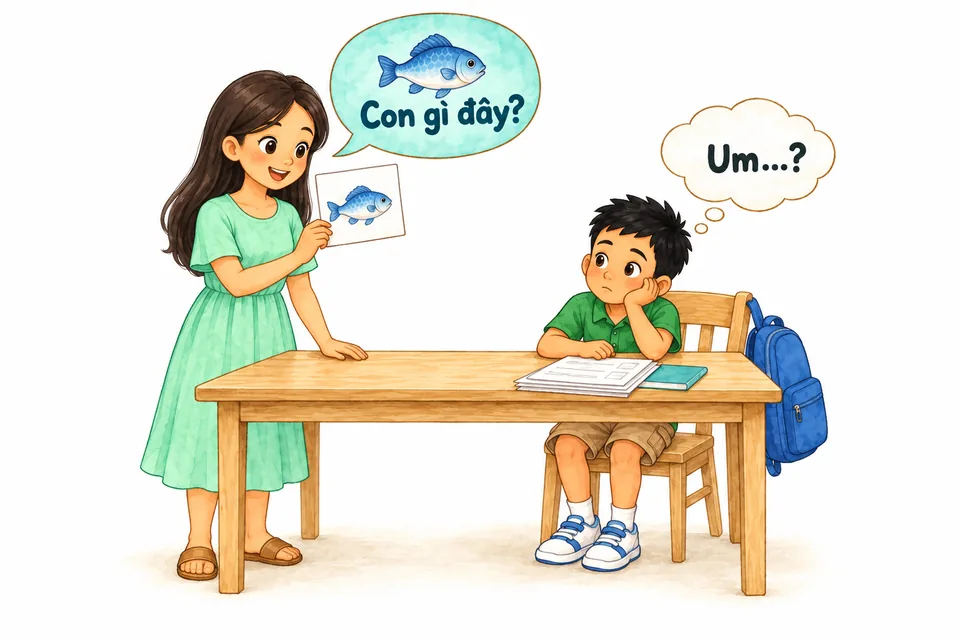
Yes. A child who understands Vietnamese but answers in English is showing one of the most common patterns in bilingual families. Researchers call it receptive, or passive, bilingualism, and what helps is giving the child more chances to speak Vietnamese, not just hear it. One research review, drawing on studies across many language pairs, estimated that roughly one in four children growing up around two languages end up speaking only the majority language (Pearson, 2007).
The reasons are ordinary:
- Once school starts, English fills most of the day, so it becomes the easier language to reach for.
- Older siblings bring English home.
- When everyone at the table understands English, conversation drifts there.
A four-year study of 33 Vietnamese–English children in the U.S. found that both languages kept growing, but the number of English words children could say grew nearly four times as fast as their Vietnamese, and by about age 8 English had become their stronger language for saying words (Pham & Kohnert, 2014).
Understanding is still a real foundation to build on. In a study of 69 children aged 5 to 8 from Vietnamese-speaking homes in California, children got about 80% of Vietnamese words right on a test of understanding, but about 36% on a test of saying them. Those are vocabulary-test scores, not a measure of overall speaking ability. How much Vietnamese they heard, plus enrichment activities, predicted their Vietnamese vocabulary (Pham & Tipton, 2018).
Ask for one word back
In a study of toddlers, how much children spoke a language predicted growth in the words they could say, separately from how much they heard (Ribot, Hoff & Burridge, 2018). So when your child answers in English, don’t scold and don’t switch. Say their idea back warmly in Vietnamese, then invite just one word.
Try this tonight
Choose one “word of the night” at dinner, such as nước (water). Each time it comes up, say it in Vietnamese, for example “Con muốn uống nước hả?” (“You want some water?”), and let your child say nước back. Cheer the try, not the perfection.
My own Vietnamese is shaky, or I don’t speak it. Can I still help?
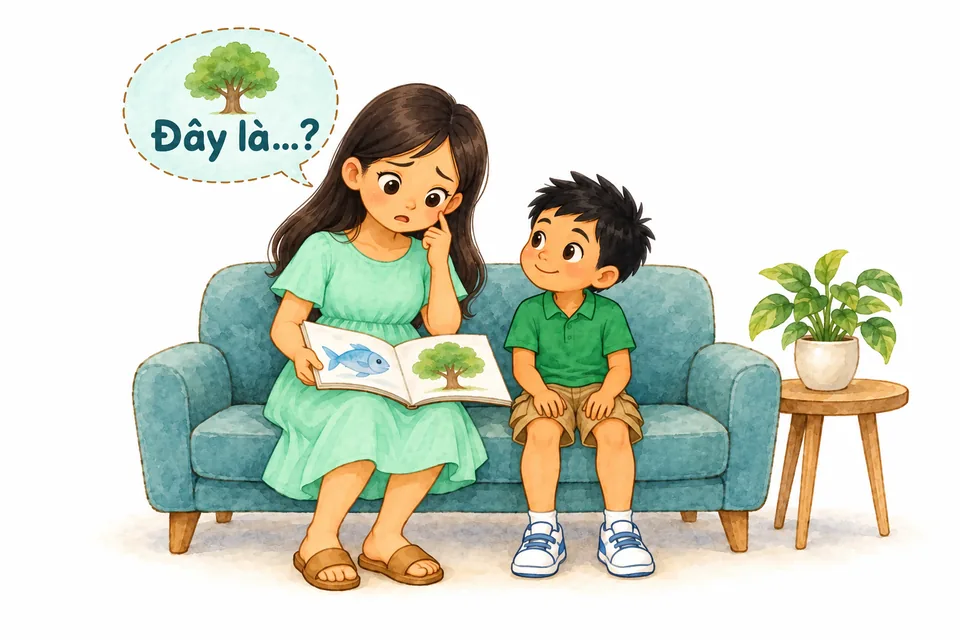 The problem
 What helps
Yes. A parent who speaks little Vietnamese, or none, can still help a child learn to speak it: you set the routine and keep it warm, while relatives, recordings and teachers supply the fluent Vietnamese.
- The American Academy of Pediatrics and ASHA both advise parents to talk with children in the language they’re most comfortable using.
- Children’s language grows from rich, fluent conversation, and speech from a parent with limited skill in a language tends to be less rich (Hoff, Core & Shanks, 2020).
So split the job. Keep your warm, everyday talk in the language you speak best. For Vietnamese, be the connector: set the time, sit beside your child and bring in fluent voices. Toddlers’ language skills were linked to how much of what they heard came from native speakers, and to how many different speakers they heard (Place & Hoff, 2011).
Borrow native voices, and learn alongside
Take new words from recordings by native speakers and repeat them together. Then let your child teach a word back to you. Recalling it is good practice for them, and it puts you on the same team.
Try this tonight
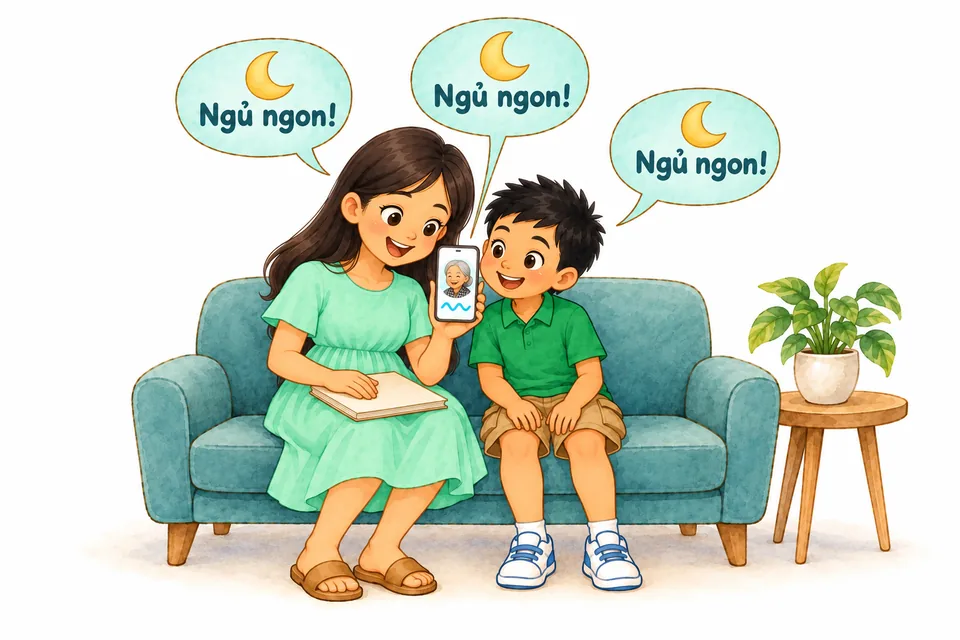
Ask a relative to send a 30-second voice memo reading one page of a picture book, or saying goodnight. Play it twice, then copy it together.
How do we get our child talking with their grandparents, Bà and Ông?
 The problem
 What helps
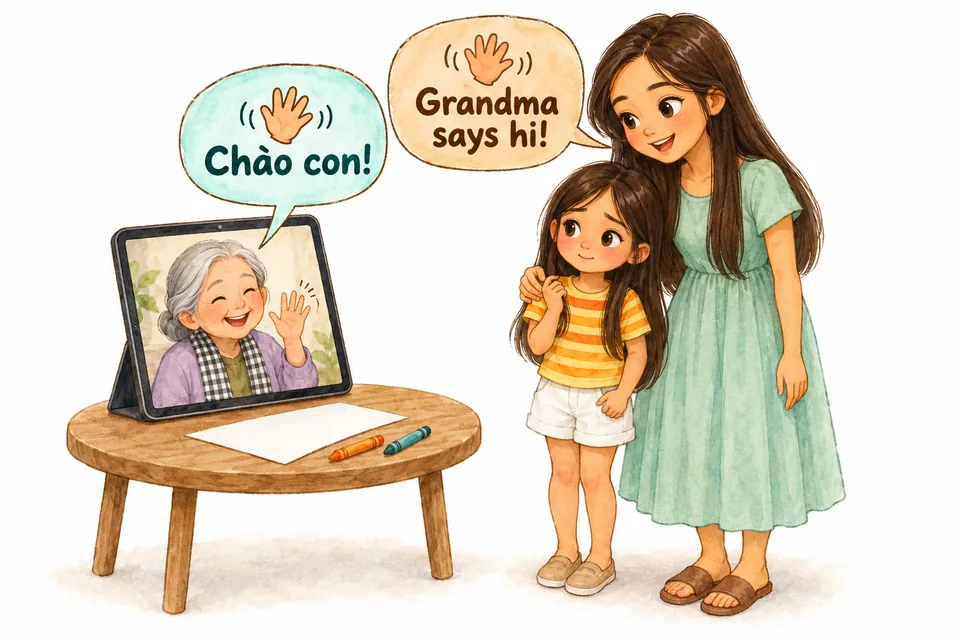
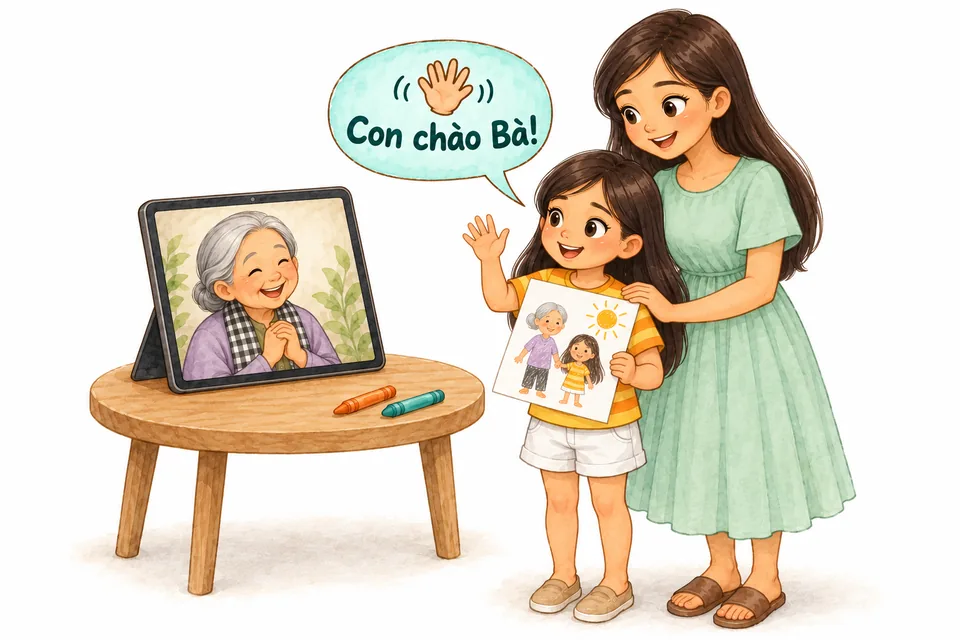
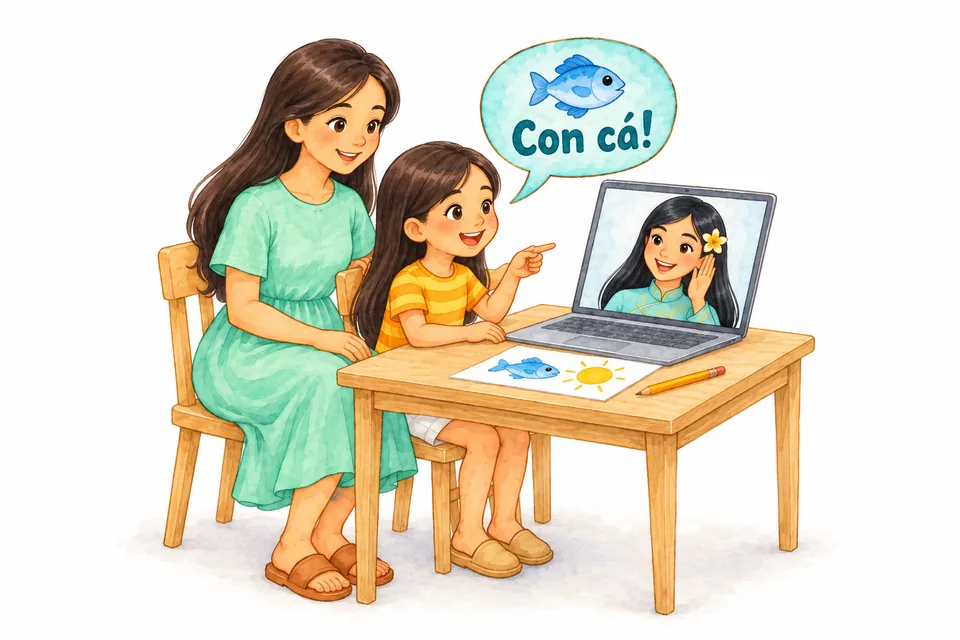
Two things help: make grandparents a regular Vietnamese voice in your child’s week, and prepare both sides of each call, with one greeting, one thing to show, and a grandparent who speaks slowly and waits for an answer.
Grandparents are often why families keep going, and they can give a child a real need to use Vietnamese. The number of different heritage-language speakers people talked with as children was linked to stronger heritage-language skill, without lowering their English (Gollan, Starr & Ferreira, 2015).
Video calls count. In a lab study, toddlers learned new words from a live video chat but not from the same video played back without anyone responding (Roseberry, Hirsh-Pasek & Golinkoff, 2014).
Add one speaker, and prepare both sides of the call
- Ask relatives to keep using Vietnamese with your child, slowly and patiently. In an interview study of trilingual families in England and Germany, grandparents who lived nearby often spoke the local language with their grandchildren (Braun, 2012).
- Give your child a script: one greeting and one thing to show.
Try this tonight
Draw a “speaker map” with your child showing everyone who speaks Vietnamese to them. Pick one person to call this week, and rehearse the greeting your family uses with them. For a full call plan, see A First Vietnamese Conversation with Grandparents.
Is weekend Vietnamese school enough?
 The problem
 What helps
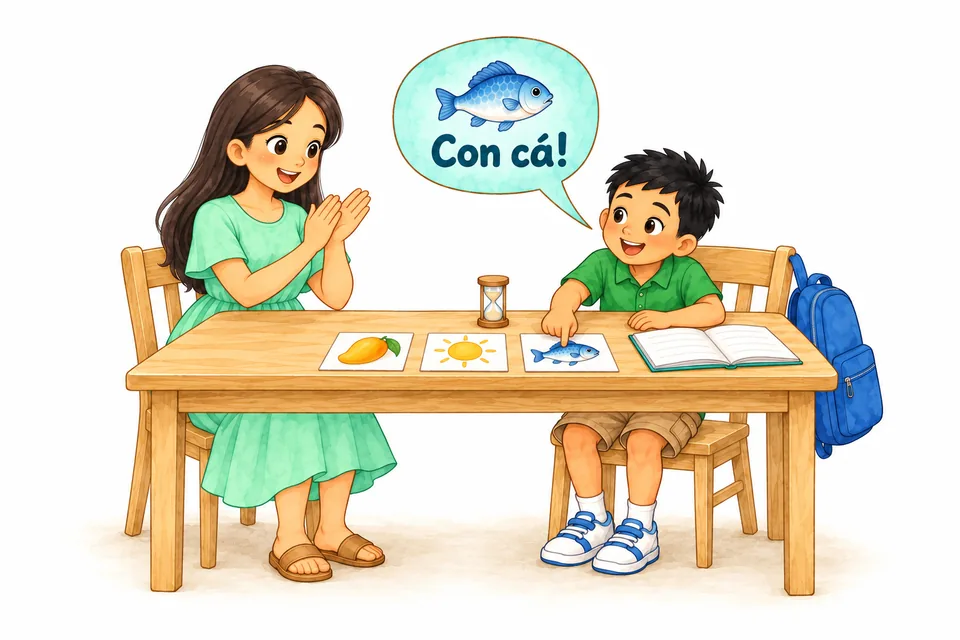
Weekend Vietnamese school is worth keeping, but a few hours a week is rarely enough on its own. Classes give children a teacher, structure, friends who share their heritage, and a reason to show up. But classes are short:
- Center for Applied Linguistics profiles of U.S. heritage-language schools describe classes of about two to three hours a week (Center for Applied Linguistics).
- A volunteer teacher at a Vietnamese class in Omaha said that students who don’t use the language often at home, “I’d say they’ll lose it” (Nebraska Public Media, 2016).
Research on how much weekend classes add is thin. The one U.S. study of a Vietnamese language school linked attendance to some Vietnamese skills (Maloof, Rubin & Miller, 2006). Classes help most when the language also lives at home.
Bring the class home midweek
Memory research consistently finds that spreading practice out works better than cramming it into one session (Cepeda et al., 2006). A short recall game midweek turns one weekly class into several touches.
Try this tonight
Ask your child, or the teacher, for this week’s words. On two weeknights, play a three-minute “do you remember?” game before adding anything new.
My child refuses, gets embarrassed or says it’s boring. What helps?
 The problem
 What helps
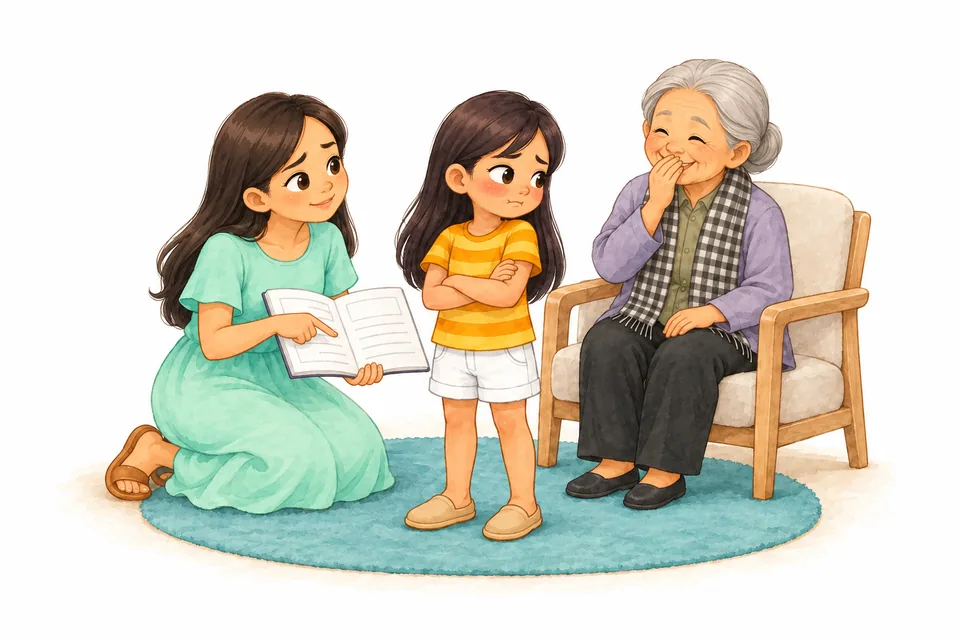
When a child refuses to speak Vietnamese or is embarrassed by it, lower the pressure and protect the relationship. Research links anxiety with avoiding a language, and closeness with using it:
- Researchers who interviewed heritage speakers describe a cycle: anxiety about speaking leads to avoiding the language, and avoiding it weakens the skill (Sevinç & Backus, 2019).
- Embarrassment often comes from being laughed at or corrected in front of fluent relatives.
- Among teens in immigrant families, a close relationship with parents predicted later use of the home language, rather than the other way round (Tseng & Fuligni, 2000).
Connection comes first.
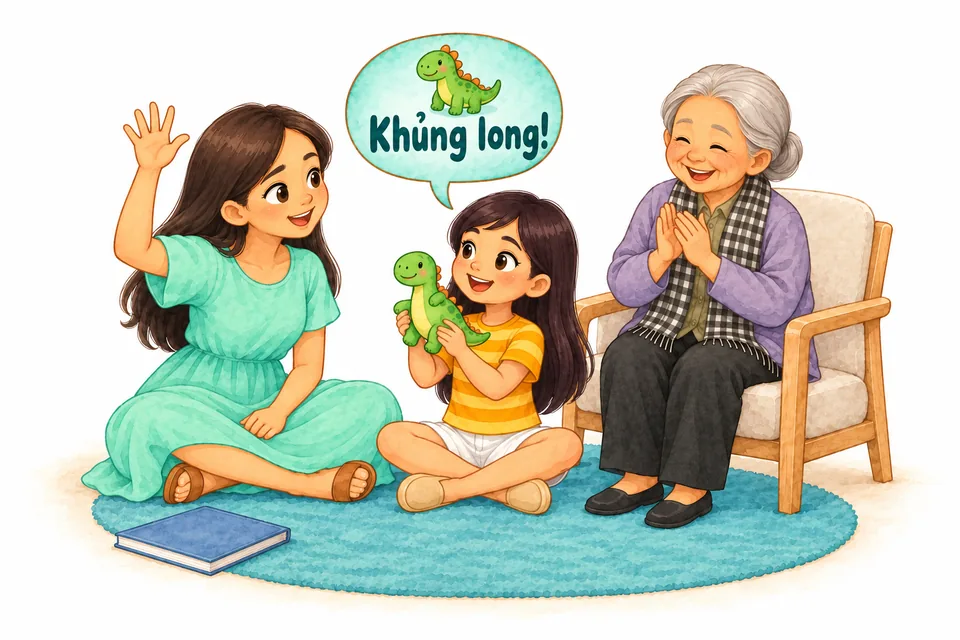
Give your child the choice, and protect the try
- Let your child pick the topic (dinosaurs, cooking, a favorite show). Learners engage more when learning feels meaningful and in their control (Comanaru & Noels, 2009).
- Ask relatives to cheer attempts and skip corrections in front of others. You can model the word casually later.
Try this tonight
Ask, “What’s one thing you’d like to be able to say in Vietnamese?” Find it together from a native-speaker recording, and let your child try it on someone tomorrow.
Is 10 minutes a day enough, and how should we spend it?
 The problem
 What helps
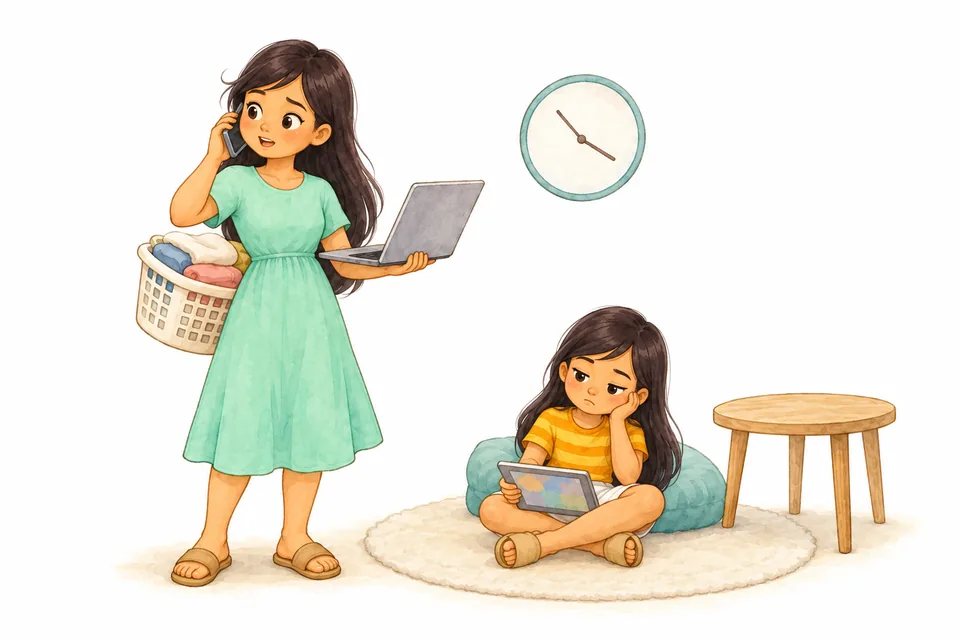
Ten minutes a day is not enough on its own to make a child fluent; fluency takes many hours of real conversation. But ten steady minutes keep Vietnamese growing and make it a normal part of the day. These three habits have good evidence behind them.
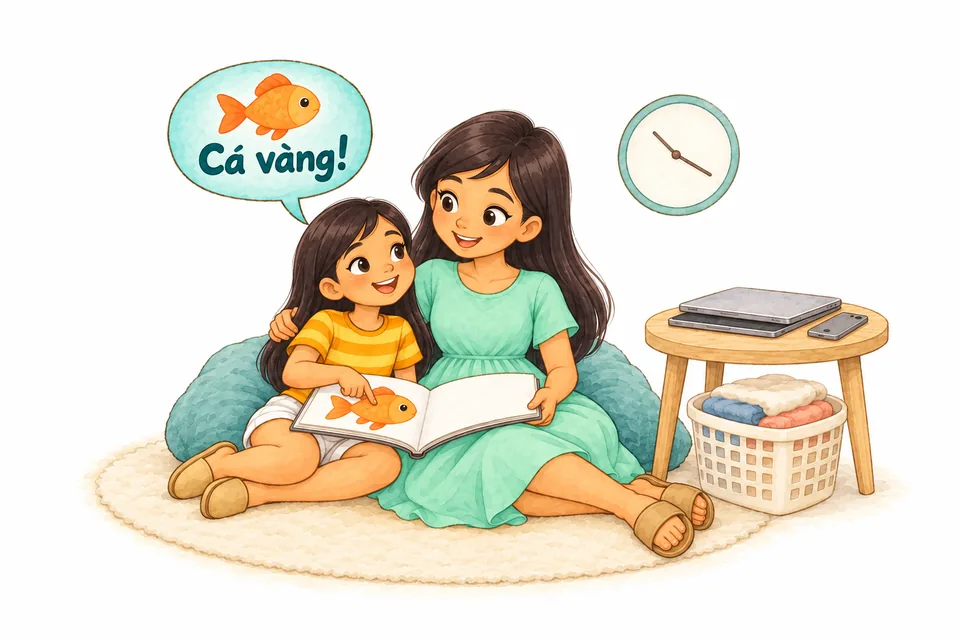
Read one picture, and ask questions
- In “dialogic reading”, the adult asks about the pictures and builds on the child’s answers. It has positive effects on young children’s spoken language (What Works Clearinghouse, 2007).
- In a study of Hmong- and Spanish-speaking preschoolers, reading at home in the family language worked as well as reading in English for building English vocabulary (Roberts, 2008).
Need a book? Browse our Vietnamese–English picture books, or use the free bilingual reading activity kit.
Try this tonight
Open a Vietnamese–English picture book to one page. Point to three things and ask what they are. Accept answers in either language, then say the Vietnamese word in a short phrase. Tomorrow, read the same page and let your child do more of the telling.
Sing it, then say it
- Songs help children recognize and remember words, but they’re weaker at getting children to say new words on their own (Coyle & Gómez Gracia, 2014).
- Melodies in Vietnamese songs only partly follow the language’s tones (Kirby & Ladd, 2016), so pair singing with ordinary speech.
Try this tonight
Sing one short Vietnamese children’s song twice, with hand motions. The third time, pause before a key word and let your child fill it in. Then say that word in a normal speaking voice.
Same time, same place, every day
Attach Vietnamese to something you already do: the drive to school, bath time or bedtime. Start with a one-minute “do you remember?” round, because recalling words builds memory better than rereading them, for children too (Karpicke, Blunt & Smith, 2016). Then add no more than two or three new words.
Try this tonight
Pick your slot and set a phone reminder for the same time tomorrow. Write down tonight’s words so tomorrow can start with “do you remember?”
Will Vietnamese at home slow down English or cause a speech delay?
 The problem
 What helps
No. Speaking Vietnamese at home does not slow down a child’s English or cause a speech delay. The American Academy of Pediatrics and ASHA say that learning more than one language does not cause speech or language problems, and that a true difficulty shows up in all of a child’s languages.
- Vietnamese-specific studies agree. In the U.S., parents’ Vietnamese use was not related to children’s English vocabulary (Pham & Tipton, 2018). In a survey of 151 Vietnamese-Australian parents, families reported that their children’s Vietnamese did not hold back their English (Tran et al., 2021).
- Mixing is normal. Using both languages in one sentence is a normal part of bilingual development.
This article offers learning support, not medical advice.
FAQ
Should I pretend I don’t understand English?
You don’t need to. Research on this is small and mixed. The studies looked at parents asking for a repeat or saying “What?”, not at pretending: in a five-family study, children often just repeated what they had said, in the same language (Nicoladis & Genesee, 1998). Some parents say their children find pretending upsetting. A gentler approach is what many families find helpful, and a small four-child study points the same way. Make your preference clear and warm, restate your child’s idea in Vietnamese, and invite one word back (Kasuya, 1998).
How long until my child starts answering in Vietnamese?
No study gives a timeline. It depends on your child’s age, how much Vietnamese they hear and who they talk with. Watch for small wins: one Vietnamese word in an answer, joining a song, greeting a grandparent without a prompt. Write them down so you can see progress.
Is it too late if my child is 9, 10 or 12?
No. The AAP and ASHA note that older children can still learn a language with frequent exposure and regular practice. Older kids often do best with more choice and a real person to talk to. Some preteens and teens go through a phase of not caring about their heritage language, which can be followed by renewed interest (Tse, 2000).
Does Vietnamese TV or YouTube count?
It helps most when you watch together and talk about it. In a review of 42 studies, watching with a parent and choosing educational programs were linked with stronger language skills, while background TV was linked with weaker ones (Madigan et al., 2020). Pause a short Vietnamese clip two or three times to ask what happened.
Should we use “one parent, one language”?
It can work, but it isn’t required. In a survey of 1,899 bilingual families in Belgium, children most often spoke the home language when both parents used it at home; “one parent, one language” was neither necessary nor enough on its own (De Houwer, 2007). Many families mix approaches: Vietnamese at certain routines, with grandparents, or for part of every day. If only one parent speaks Vietnamese, focus on that parent’s steady use and on adding other Vietnamese speakers to the child’s week, rather than on a strict rule.
Want more help at home?
Try Say Việt with your child
If you’d like more help, try our Say Việt app. Say Việt is Achieve Education’s online Vietnamese course for English-speaking kids ages 4 to 12. It’s built for the gap this article keeps coming back to: native Vietnamese to hear, and real turns to speak, even when a parent isn’t fluent.
- Cô Vi, Say Việt’s virtual coach, models every word with recorded audio, and AI speaking practice listens as your child says it back.
- 20 lessons and Story Time books, plus printable worksheets for practice off-screen.
- It runs in your web browser, with nothing to download.
First lesson free · then $29 a month or $275 a year
Say Việt works alongside family conversations and weekend Vietnamese school, never instead of them.
Sources
All links and DOIs were checked in October 2026.
- Pearson, B. Z. (2007). Social factors in childhood bilingualism in the United States. Applied Psycholinguistics, 28(3), 399–410. https://doi.org/10.1017/S014271640707021X The “about one in four” estimate; why the majority language takes over.
- Pham, G., & Kohnert, K. (2014). A longitudinal study of lexical development in children learning Vietnamese and English. Child Development, 85(2), 767–782. https://doi.org/10.1111/cdev.12137 33 children over four years; English grew faster.
- Pham, G., & Tipton, T. (2018). Internal and external factors that support children’s minority first language and English. Language, Speech, and Hearing Services in Schools, 49(3), 595–606. https://doi.org/10.1044/2018_LSHSS-17-0086 Understanding vs saying; Vietnamese at home did not hinder English.
- Ribot, K. M., Hoff, E., & Burridge, A. (2018). Language use contributes to expressive language growth: Evidence from bilingual children. Child Development, 89(3), 929–940. https://doi.org/10.1111/cdev.12770 Speaking builds the words children can say.
- Hoff, E., Core, C., & Shanks, K. F. (2020). The quality of child-directed speech depends on the speaker’s language proficiency. Journal of Child Language, 47(1), 132–145. https://doi.org/10.1017/S030500091900028X Why parents should use their strongest language.
- Place, S., & Hoff, E. (2011). Properties of dual language exposure that influence 2-year-olds’ bilingual proficiency. Child Development, 82(6), 1834–1849. https://doi.org/10.1111/j.1467-8624.2011.01660.x Native-speaker input and the number of speakers.
- Gollan, T. H., Starr, J., & Ferreira, V. S. (2015). More than use it or lose it: The number-of-speakers effect on heritage language proficiency. Psychonomic Bulletin & Review, 22(1), 147–155. https://doi.org/10.3758/s13423-014-0649-7 More speakers, stronger heritage language.
- Roseberry, S., Hirsh-Pasek, K., & Golinkoff, R. M. (2014). Skype me! Socially contingent interactions help toddlers learn language. Child Development, 85(3), 956–970. https://doi.org/10.1111/cdev.12166 Toddlers learn words from live video chat.
- Braun, A. (2012). Language maintenance in trilingual families: A focus on grandparents. International Journal of Multilingualism, 9(4), 423–436. https://doi.org/10.1080/14790718.2012.714384 Grandparents nearby may switch to the local language.
- Nebraska Public Media (2016). Classes provide young Vietnamese Nebraskans link to language and culture. https://nebraskapublicmedia.org/en/news/news-articles/classes-provide-young-vietnamese-nebraskans-link-to-language-and-culture/ The volunteer teacher’s quote.
- Center for Applied Linguistics. Heritage Language Schools briefs (Chinese, 2010; Korean, 2011). https://www.cal.org/resource-center/resource-archive/heritage-languages-schools-briefs/ Typical weekly class hours.
- Maloof, V. M., Rubin, D. L., & Miller, A. N. (2006). Cultural competence and identity in cross-cultural adaptation: The role of a Vietnamese heritage language school. International Journal of Bilingual Education and Bilingualism, 9(2), 255–273. https://doi.org/10.1080/13670050608668644 Attendance linked to some Vietnamese skills.
- Cepeda, N. J., Pashler, H., Vul, E., Wixted, J. T., & Rohrer, D. (2006). Distributed practice in verbal recall tasks: A review and quantitative synthesis. Psychological Bulletin, 132(3), 354–380. https://doi.org/10.1037/0033-2909.132.3.354 Spaced practice beats cramming.
- Sevinç, Y., & Backus, A. (2019). Anxiety, language use and linguistic competence in an immigrant context: A vicious circle? International Journal of Bilingual Education and Bilingualism, 22(6), 706–724. https://doi.org/10.1080/13670050.2017.1306021 Anxiety, avoidance and skill.
- Tseng, V., & Fuligni, A. J. (2000). Parent–adolescent language use and relationships among immigrant families with East Asian, Filipino, and Latin American backgrounds. Journal of Marriage and Family, 62(2), 465–476. https://doi.org/10.1111/j.1741-3737.2000.00465.x Relationship quality and home-language use.
- Comanaru, R., & Noels, K. A. (2009). Self-determination, motivation, and the learning of Chinese as a heritage language. Canadian Modern Language Review, 66(1), 131–158. https://doi.org/10.3138/cmlr.66.1.131 Choice and meaning keep learners engaged.
- What Works Clearinghouse (2007). Dialogic Reading intervention report. Institute of Education Sciences. https://ies.ed.gov/ncee/wwc/Docs/InterventionReports/WWC_Dialogic_Reading_020807.pdf Positive effects on oral language, ages 3–5.
- Roberts, T. A. (2008). Home storybook reading in primary or second language with preschool children. Reading Research Quarterly, 43(2), 103–130. https://doi.org/10.1598/RRQ.43.2.1 Family-language reading worked as well for English vocabulary.
- Coyle, Y., & Gómez Gracia, R. (2014). Using songs to enhance L2 vocabulary acquisition in preschool children. ELT Journal, 68(3), 276–285. https://doi.org/10.1093/elt/ccu015 Songs help recognition more than speaking.
- Kirby, J., & Ladd, D. R. (2016). Tone-melody correspondence in Vietnamese popular song. Proceedings of TAL 2016, 48–51. https://doi.org/10.21437/TAL.2016-10 Melodies only partly follow tones.
- Karpicke, J. D., Blunt, J. R., & Smith, M. A. (2016). Retrieval-based learning: Positive effects of retrieval practice in elementary school children. Frontiers in Psychology, 7, 350. https://doi.org/10.3389/fpsyg.2016.00350 Recall beats rereading for children.
- American Academy of Pediatrics & American Speech-Language-Hearing Association. Young Children Learning Multiple Languages: Parent FAQs. HealthyChildren.org (updated Nov 20, 2025). https://www.healthychildren.org/English/ages-stages/gradeschool/school/Pages/7-Myths-Facts-Bilingual-Children-Learning-Language.aspx No delay from bilingualism; use your comfortable language; when to seek help.
- ASHA / Communication Health Support Association. Learning More Than One Language. https://helpingyoucommunicate.org/article/learning-more-than-one-language Parent guidance; “If you’re concerned, talk to a speech-language pathologist.”
- Tran, V. H., Wang, C., McLeod, S., & Verdon, S. (2021). Vietnamese–Australian children’s language proficiency and use. International Journal of Bilingualism, 25(6), 1735–1763. https://doi.org/10.1177/13670069211034587 151 families; Vietnamese did not hold back English.
- Madigan, S., McArthur, B. A., Anhorn, C., Eirich, R., & Christakis, D. A. (2020). Associations between screen use and child language skills. JAMA Pediatrics, 174(7), 665–675. https://doi.org/10.1001/jamapediatrics.2020.0327 Co-viewing and quality content vs background TV.
- De Houwer, A. (2007). Parental language input patterns and children’s bilingual use. Applied Psycholinguistics, 28(3), 411–424. https://doi.org/10.1017/S0142716407070221 1,899 families; both parents using the home language.
- Nicoladis, E., & Genesee, F. (1998). Parental discourse and codemixing in bilingual children. International Journal of Bilingualism, 2(1), 85–99. https://doi.org/10.1177/136700699800200104 “Pretend not to understand” didn’t replicate.
- Kasuya, H. (1998). Determinants of language choice in bilingual children: The role of input. International Journal of Bilingualism, 2(3), 327–346. https://doi.org/10.1177/136700699800200304 Clear, warm preference for the home language.
- Tse, L. (2000). The effects of ethnic identity formation on bilingual maintenance and development: An analysis of Asian American narratives. International Journal of Bilingual Education and Bilingualism, 3(3), 185–200. https://doi.org/10.1080/13670050008667706 The preteen/teen ambivalence phase.
How we made this: We researched this guide with the help of AI tools, drawing on published studies and public parent discussions. Kimly Hoang-Nakata, M.Ed., wrote and approved it, and Roger Nakata, D.O. Board Certified Pediatrician, reviewed it. Kimly checked every Vietnamese word on this page. It offers learning support, not medical advice.