Bilingual Parenting
How do I read a Vietnamese–English picture book with my child?
You don’t need to read Vietnamese. Give each grown-up one job, ask a few questions about the pictures, and read the same book again until your child tells it back.
Updated
The short answer
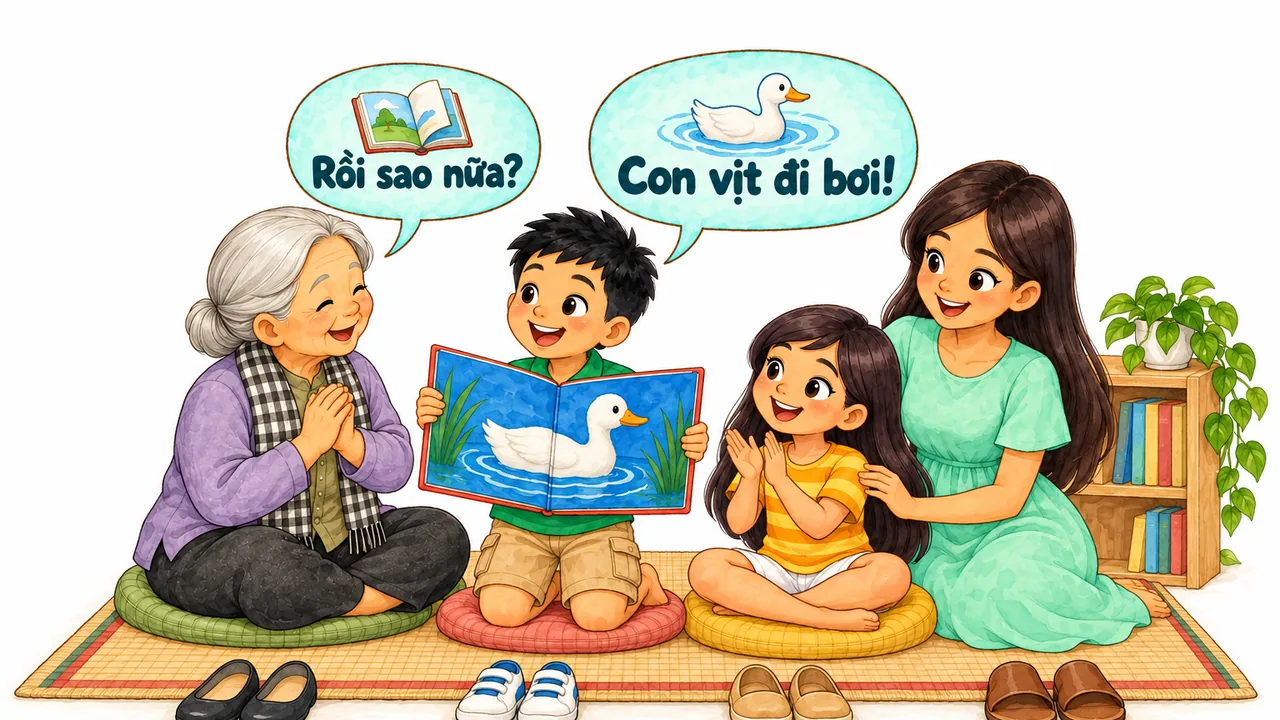
Make it a conversation, not a translation. Talk about the pictures, ask a question or two as you go, and let your child answer in Vietnamese, English or both. This way of sharing a book is called dialogic reading, and in U.S. preschool studies run in English, the What Works Clearinghouse found it improved children’s spoken language (What Works Clearinghouse, 2007). Later, larger reviews of shared reading find real but small gains (Noble et al., 2019) (Dowdall et al., 2020).
You don’t need to read Vietnamese well: you don’t have to read a book to tell its story (Reach Out and Read). Lead the talk in the language you’re most comfortable using (AAP & ASHA), and ask a confident reader, such as Bà (Grandma) or a Saturday-school teacher, to read one short Vietnamese passage.
Then, over the next few days, read the same book again. A What Works Clearinghouse guide suggests two to four readings, with a different focus each time (What Works Clearinghouse, 2022). As the book becomes familiar, read less and let your child tell more (What Works Clearinghouse, 2007). One passage, one word, a few questions, and the same book again. The free sheet below works with any Vietnamese–English picture book.
Open the printable reading response sheet — A free one-page sheet to print from your browser, with short adult instructions. No account required.
Key takeaways
- You don’t have to read Vietnamese to share a bilingual book. Talk about the pictures (Reach Out and Read), and borrow a confident voice for one short passage.
- Give each language its own job: talk in one, and have the passage read once in the other (Celic & Seltzer, CUNY-NYSIEB). There’s no need to read every line twice.
- Ask, don’t quiz. You don’t need a question on every page; keep it fun (Colorín Colorado).
- Answers in English count: mixing two languages is normal (AAP & ASHA). Say the idea back in a short Vietnamese phrase and invite one word.
- Read the same book two to four times (What Works Clearinghouse, 2022). Each time, read less and let your child tell more (What Works Clearinghouse, 2007).
What does a 10-minute bilingual read-aloud look like?
Use any picture book; a Vietnamese–English edition is easiest. Share the whole book the way you usually do, talking about the pictures, and stop at one page for these four steps. They match the four parts of the free sheet, so the sheet doubles as your script.
- 1. Look. Before reading, open to one picture and ask “What do you notice?” or Con thấy gì trong hình này? (“What do you see in this picture?”). Your child points, names or draws one detail.
- 2. Listen. Your Vietnamese reader reads one short passage while you point to the words; pause before a repeated word. Your child listens, joins in and picks one word to keep.
- 3. Connect. Link the page to your child’s life: “Does anything here remind you of something you know?” or Nhà mình có cái này không? (“Do we have this at home?”). Your child shares a connection, says “I wonder…”, or passes.
- 4. Revisit. Go back to the word and the picture: “Where did we hear this?” Your child says the word in either language and picks a part to hear again.
Stop while it’s still fun. In dialogic-reading studies that reported it, 5 to 15 minutes a day was most common, though a 2022 review found no study that had tested the best amount (Pillinger & Vardy, 2022).
Before you start (about five minutes):
- Preview the actual edition you will read. Choose a short passage, two or three lines, and a picture that invites talk.
- Choose one Vietnamese word from the passage. Check its spelling, meaning, and pronunciation with the reader before the session; one tone mark can change the word (Pham & Kohnert, 2014).
By age: in dialogic-reading studies, the most common age range was 2 to 5 (Pillinger & Vardy, 2022). With a toddler, point and pause so they can finish a familiar line (Reach Out and Read). With a preschooler, try the five kinds of questions below; by the third reading, let them tell parts of the story. Older children can retell it all, or read a line aloud if they’re learning to read Vietnamese.
I don’t read Vietnamese well. Can I still do a bilingual read-aloud?
Teal speech bubbles mean Vietnamese.Orange ones mean English.
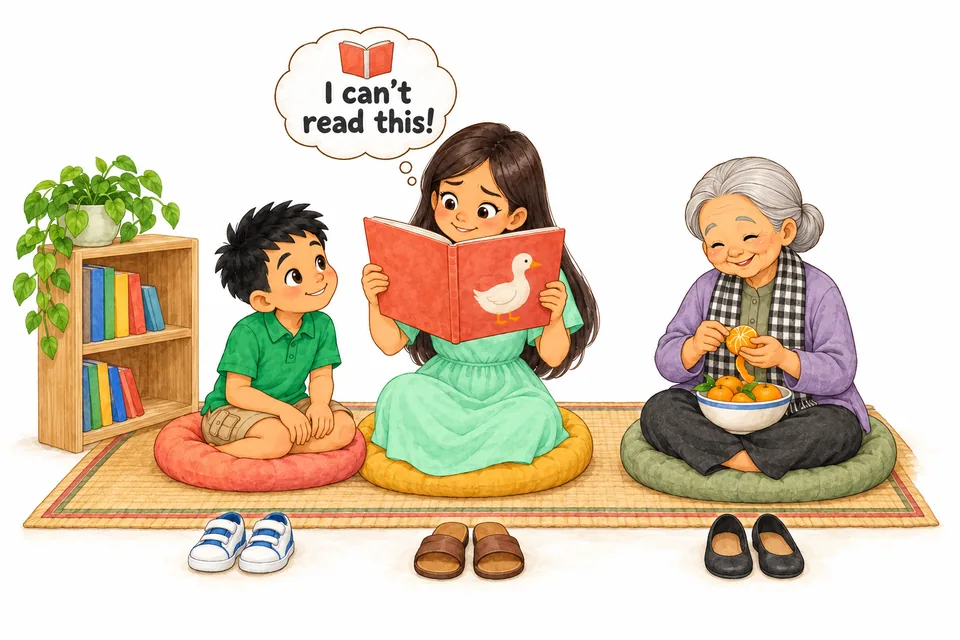 The problem
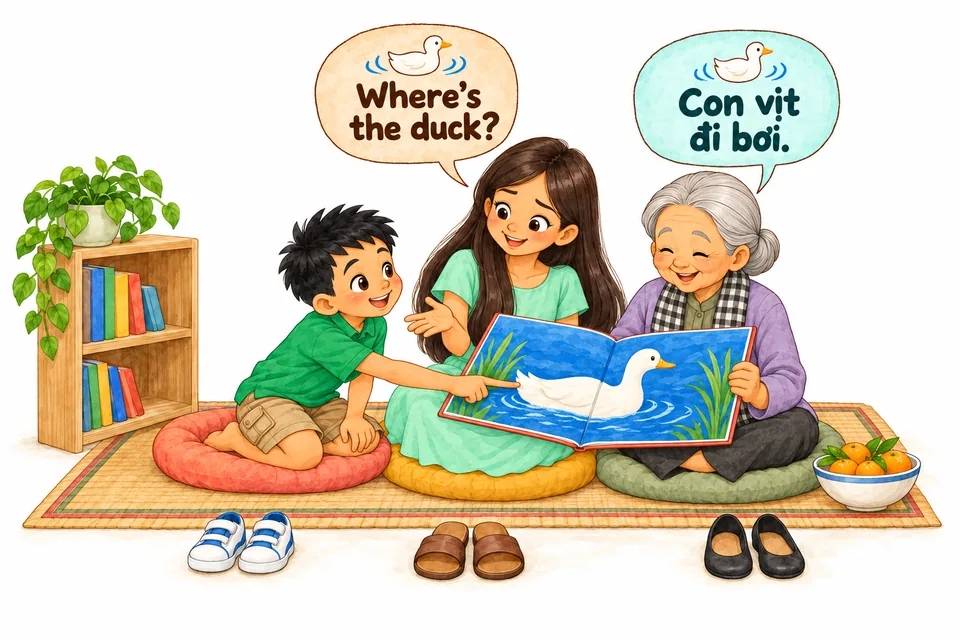 What helps
Yes. Split the job: you lead the talk in the language you’re most comfortable using (AAP & ASHA), and someone confident in Vietnamese reads the one short passage. Talk about the pictures, too; you don’t have to read a book to tell its story (Reach Out and Read).
Who can read the passage? Easiest first:
- Bà, Ông (Grandma, Grandpa) or another relative, in person or on a video call (here’s a call plan).
- A Saturday-school teacher, neighbor or librarian who reads Vietnamese.
- A family voice memo: a relative records the passage for you to replay at home, as our guide to teaching your child Vietnamese at home suggests. Keep it on your phone; don’t post or share it.
- Authorized audio (the sheet’s phrase): a recording released by the book’s author or publisher, if your book has one.
- No reader yet? Skip step 2 for now: talk about the pictures in your language, and use one question from the Vietnamese question list once a Vietnamese speaker has said it for you. Our own Vietnamese course for kids, Say Việt, also has Story Time books: its own illustrated bilingual stories to listen along to and read aloud. Say Việt works alongside family reading and weekend Vietnamese school, never instead of them.
Give every grown-up one job
- The reader reads the Vietnamese passage, the same way every time.
- The talker, often you, asks about the pictures in your strongest language. If your reader can stay, they can ask a question or two in Vietnamese, too: in a study of 5- to 8-year-olds from Vietnamese-speaking homes, the amount of Vietnamese they heard, and Vietnamese activities such as books and storytelling, were the home factors that best predicted their Vietnamese vocabulary (Pham & Tipton, 2018).
- The word-keeper writes one word from the passage on the sheet, with the reader’s help. A parent who speaks no Vietnamese makes a great talker or word-keeper.
Try this tonight
Text one Vietnamese speaker you know: “Would you read two lines of a picture book with us this week?” Pick the passage together, and hear it yourself first.
Dialogic reading: how do I ask questions without turning storytime into a quiz?
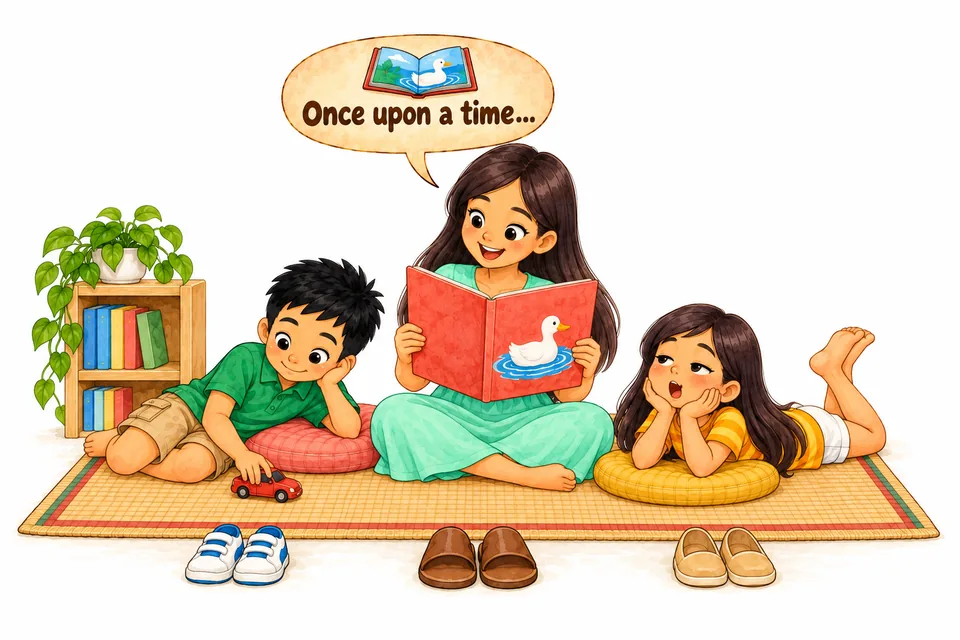 The problem
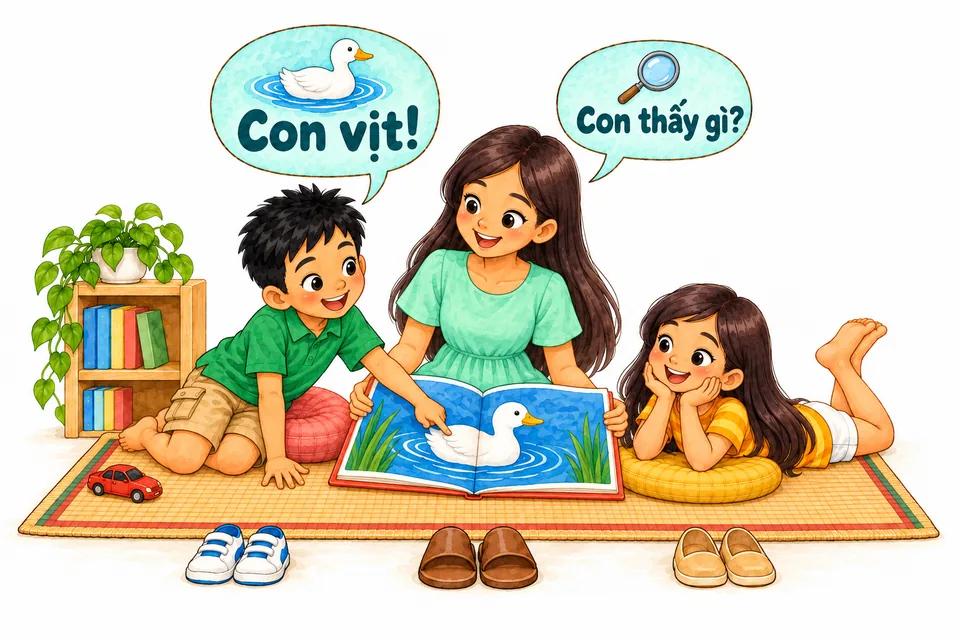 What helps
Hand the story over. In dialogic reading, adult and child switch roles: the child becomes the storyteller, and the adult listens, asks and builds on the answers (What Works Clearinghouse, 2007). As a book becomes familiar, the adult reads less and listens more (What Works Clearinghouse, 2007). You don’t need a question on every page; keep it fun (Colorín Colorado).
The PEER loop: ask, add a little, ask again
The adult’s loop is called PEER: prompt, evaluate, expand, repeat (What Works Clearinghouse, 2007). You can run it with a few Vietnamese phrases, even if you don’t read Vietnamese. One tip: con does two jobs. In Con thấy gì? it means “you”, as a parent says it to a child; in con vịt it comes before an animal’s name (Pham & Kohnert, 2008).
- Prompt: Con thấy gì? (“What do you see?”)
- Evaluate: Đúng rồi! (“That’s right!”), or a warm nod. If the answer isn’t quite right, skip the “no” and just say the right word as your expand.
- Expand: add a word or two. Your child says Con vịt! (“A duck!”); you say Ừ, con vịt đang bơi! (“Yes, the duck is swimming!”).
- Repeat: ask again, so your child can say the longer version.
Try this tonight
Ask your Vietnamese reader to say Con thấy gì? (“What do you see?”) a few times, and learn it by heart. Ask it on two pages tonight, accept either language, and add one word to the answer.
Dialogic reading also names five kinds of prompts, called CROWD (What Works Clearinghouse, 2007). Here they are in both languages. Ask your reader to say them for you first, then pick one or two to try.
- Completion: pause before the last word of a line for your child to fill in. Rhymes make this easy.
- Recall: Con còn nhớ chuyện gì xảy ra không? (“Do you remember what happened?”)
- Open-ended: Chuyện gì đang xảy ra trong hình này? (“What’s happening in this picture?”)
- Wh- questions: Con gì đây? (“What animal is this?”), Cái gì đây? (“What’s this?”), Ai đây? (“Who’s this?”)
- Distancing, linking the book to your child’s life: Nhà mình có cái này không? (“Do we have this at home?”)
Which language goes where? Do I read every line twice?
No. Plan where each language goes instead: talk about the cover and pictures in one language, have the passage read once in the other without stopping to translate, then talk again. In one study, 42 Spanish-speaking preschoolers heard culturally familiar books in English only or in a planned order (Spanish, then both, then English, over three days each week for five weeks). The planned group knew more of the target words in both languages at the end, though standardized vocabulary scores didn’t differ, and three weeks later only the Spanish advantage remained (Méndez et al., 2015).
Teachers call this shape preview, view, review, and a family member can do the preview in the home language (Celic & Seltzer, CUNY-NYSIEB). Letting children answer in either language, drawing on all they know, is part of what educators call translanguaging (Celic & Seltzer, CUNY-NYSIEB).
Talk in one language, read in the other
- A Vietnamese–English edition: your reader reads the Vietnamese passage once, without stopping to translate; you talk about the pictures before and after in your language. Save the English text of that page for another day.
- A Vietnamese-only book: your reader reads; everyone talks about the pictures in either language.
- An English book: read it as usual, then talk about the pictures in Vietnamese, or have your Vietnamese speaker do it. ASHA suggests talking about pictures, characters and story in more than one language (ASHA).
Try this tonight
Talk about the cover for a minute in your best language, have the Vietnamese passage read once without stopping to translate, then ask one question about the picture.
My child answers in English during the story. Is that OK?
Yes. An English answer may simply mean the English word came faster, not that the Vietnamese is gone. In a four-year study of 33 Vietnamese–English schoolchildren in Florida, aged 6 to 11 and taking Vietnamese classes at school, English soon became the stronger language for saying words, while understanding words grew at a more similar pace in both (Pham & Kohnert, 2014). Mixing the two languages is also normal, and learning more than one doesn’t cause confusion or delay (AAP & ASHA). If you’re worried about how your child talks or understands, talk with a speech-language pathologist (ASHA) or your pediatrician (AAP & ASHA, 2018). A true speech or language problem shows up in all the languages a child uses (AAP & ASHA).
Say it back, then invite one word
This is PEER’s evaluate step, in Vietnamese (Colorín Colorado): a warm echo, never a correction. ASHA’s advice is to value practice over perfection (ASHA). When you can, expand it too, as in strategy 2.
For the bigger picture, see what to do when your child answers in English and whether Vietnamese at home slows down English.
Try this tonight
When your child says “Duck!”, smile and answer Đúng rồi, con vịt! (“That’s right, a duck!”), then point and pause. If your child says con vịt, cheer the try; if not, use it again tomorrow.
Isn’t reading the same book again boring?
Not to young children: toddlers like to hear the same book over and over (Reach Out and Read). A What Works Clearinghouse practice guide says children can learn more from a book read several times, and suggests reading it two to four times, with a different focus each time (What Works Clearinghouse, 2022). In one small study, 3-year-olds who heard the same story three times in a row learned its new words and still knew them days later; children who heard the same words in three different stories didn’t keep them (Horst et al., 2011).
Three readings, three jobs for your child
- Reading 1 (tonight): the four steps. Your child looks, points and picks the word.
- Reading 2 (tomorrow): pause for your child to finish lines and say the word. Ask Con gì đây? (“What animal is this?”).
- Reading 3 (the day after): your child tells the story from the pictures, in either language. You listen, add a word, and ask Rồi sao nữa? (“And then what?”).
Try this tonight
End tonight’s reading with Con muốn nghe lại đoạn nào? (“Which part do you want to hear again?”) and mark that page with a sticky note. That’s part 4 of the sheet, and where tomorrow starts.
How do I use the free response sheet?
Print the reading response sheet — One Letter page; print from your browser at 100% scale.
Fill it in during or right after the reading; the drawing can wait until tomorrow. The one-page sheet, “Read, notice, connect,” has lines for a name (optional), the date, and the book title and edition, then four parts: 1. Something I noticed (draw or describe a detail), 2. One word from our reading (in Vietnamese and English), 3. My connection or question (“This reminds me of…” or “I wonder…”) and 4. A part I would like to hear again.
A younger child can draw and dictate while an adult writes. A child who reads independently can add a sentence and point to the part of the book that supports it.
Keep the sheet with the book: part 4 and the chosen word tell you where the next reading starts. Treat a finished sheet as a record of what a child noticed and chose in that reading.
Which Vietnamese–English books work well?
Any book with pictures worth talking about will work, even an English one: ASHA suggests talking about the pictures and story in more than one language (ASHA). A What Works Clearinghouse guide advises that children need to see people like themselves in books; if you have none, try the library or make a simple book from family photos (What Works Clearinghouse, 2022). Our own bilingual (dual-language) picture books, by Kimly Hoang-Nakata, M.Ed., fit this kit well:
- Bringing in Tết: English and Vietnamese on every page, plus a glossary and essential questions, such as “How does your family welcome the new year?” Pair it with our Tết family-memory activity.
- Bringing in the Mid-Autumn Moon Festival: rhyming poems, a glossary and essential questions. Rhymes make Completion prompts easy.
- Mai’s Story: The Legacy of Áo Dài: rhymes in both languages and names four feelings in both: háo hức (excited), lo lắng (worried), dũng cảm (brave) and tự hào (proud). Pick one as your word, and see what to say when your child has big feelings for more.
- Grandma’s Bánh of Love: Bà Ngoại (Grandma, on Mom’s side) guides young readers, and the book’s page says you don’t need to speak Vietnamese to enjoy it.
- Bringing in the Boba and Bringing in the Strawberries!: bilingual rhyming books.
- A Different Pond by Bao Phi, illustrated by Thi Bui, a 2018 Caldecott Honor book (ALSC), is in English: read it, then talk about it in Vietnamese.
If a book’s Vietnamese word isn’t the one Bà uses, both can be right; see which Vietnamese your child should learn.
See all our Vietnamese–English picture books
How do I run this in a class or library storytime if I don’t speak Vietnamese?
Bring in a Vietnamese reader and keep your usual storytime shape. You don’t need to be fully bilingual to lead a bilingual storytime; partner with community members, colleagues or volunteers (Ting, ALSC, 2025).
- Check the Vietnamese passage and word with a bilingual colleague, and don’t guess a child’s languages from their name or appearance (Breiseth, Colorín Colorado). With a group, ask Các con thấy gì? (“What do you all see?”).
- Let every child answer their own way: aloud, by drawing, pointing or writing. Avoid making an individual child responsible for translating for the group.
- Explain why you ask: in some cultures, adults ask children questions mainly after a mistake, so a question can feel like trouble. Say “I want to hear what you think,” let children point to the picture, and let them practice with a partner first (What Works Clearinghouse, 2022).
- Open and close with a bilingual welcome and goodbye song (Ting, ALSC, 2025).
- Plan a short series with the same book, not a one-off (see above).
- Show pages live; don’t copy them. A phone document camera can show the book live during class at a nonprofit school (17 U.S.C. §110).
For a group, invite sharing; don’t require it. Children’s family experiences and language confidence differ, so a connection can be to a color, a sound, a food or another book; it need not reveal family history.
Can we copy, post or translate a picture book?
Reading your own copy aloud in person is ordinary use: at home, where it isn’t a public performance (17 U.S.C. §101), in class at a nonprofit school, or at a free storytime with no admission charge (17 U.S.C. §110) (ALSC, 2020).
- Livestreaming or posting a read-aloud of someone else’s book online generally needs the publisher’s permission, unless the work is your own or in the public domain (ALSC, 2020).
- Don’t photocopy a whole picture book for class. For nonprofit schools, the classroom-copying guidelines treat up to two published pages, with no more than 10% of the words, as fair use; anything more needs a case-by-case fair-use judgment (U.S. Copyright Office).
- Talking about a book in another language is ordinary reading. Writing out and sharing a full translation of someone else’s book needs the copyright owner’s permission (17 U.S.C. §106), because the law treats a translation as a new version of the work (17 U.S.C. §101).
You may print and share Achieve Education’s original response sheet for family, classroom, and library activities with its attribution kept intact. This permission covers the sheet, not reproductions of book text, illustrations, or recordings.
This guide offers learning support for families and educators, not medical or legal advice.
FAQ
I don’t read Vietnamese. Can I still do a bilingual read-aloud with my child?
Yes. Use the language you’re most comfortable with, as the American Academy of Pediatrics and ASHA advise (AAP & ASHA), and talk about the pictures: you don’t have to read the words to share a story (Reach Out and Read). Ask a confident Vietnamese reader, such as a grandparent, to read one short passage, and let your child answer in either language.
How long should a bilingual read-aloud take, and how often?
About 10 minutes is plenty; stop while it’s still fun. In dialogic-reading studies that reported it, 5 to 15 minutes a day was most common, though a 2022 review found no study that had tested the best amount (Pillinger & Vardy, 2022). Read the same picture book two to four times, with a different focus each time (What Works Clearinghouse, 2022).
Should I read every page of a bilingual book in both languages?
No. Talk about the pictures in one language, have one short passage read once in the other without stopping to translate, then talk again; teachers call this preview, view, review (Celic & Seltzer, CUNY-NYSIEB). In a study with Spanish-speaking preschoolers, books heard in a planned order across three days (home language, then both, then English) taught more of the study’s target words in both languages by the end of the program than English only, though general vocabulary test scores didn’t differ (Méndez et al., 2015).
What is dialogic reading, and does it work in Vietnamese?
Dialogic reading is shared picture-book reading in which the child becomes the storyteller. The adult follows a loop called PEER (prompt, evaluate, expand, repeat) and asks five kinds of questions called CROWD (completion, recall, open-ended, wh- and distancing) (What Works Clearinghouse, 2007). In U.S. preschool studies in English, mostly with children aged 3 to 5, the What Works Clearinghouse found gains in spoken language (What Works Clearinghouse, 2007); later, larger reviews of shared reading find real but small gains (Noble et al., 2019) (Dowdall et al., 2020). It has also been used in Arabic, Bangla, Chinese and Spanish (Pillinger & Vardy, 2022). Achieve Education hasn’t found a study that measured children’s results with Vietnamese books, so the evidence for Vietnamese is indirect.
Can I post a read-aloud video or a translation of a picture book for my class or storytime?
Usually not without permission. Livestreaming or posting a read-aloud of someone else’s book online generally needs the publisher’s permission (ALSC, 2020), and sharing a written translation needs the copyright owner’s permission (17 U.S.C. §106), because U.S. law treats a translation as a new version of the book (17 U.S.C. §101). This is general information, not legal advice.
Sources
All links were checked in October 2026.
- What Works Clearinghouse (2007). Dialogic Reading intervention report. Institute of Education Sciences. https://ies.ed.gov/ncee/wwc/Docs/InterventionReports/WWC_Dialogic_Reading_020807.pdf Definition, PEER and CROWD; “reads less, listens more”; created in the 1980s, first study 1988; positive effects on oral language (+19 percentile points) in five English-language U.S. preschool studies, mostly ages 3–5 and mostly low-income families.
- American Academy of Pediatrics & American Speech-Language-Hearing Association. Young Children Learning Multiple Languages: Parent FAQs. HealthyChildren.org (updated Nov 20, 2025). https://www.healthychildren.org/English/ages-stages/gradeschool/school/Pages/7-Myths-Facts-Bilingual-Children-Learning-Language.aspx Use the language you’re most comfortable with; no confusion or delay; mixing is normal; a speech or language problem shows up in all of a child’s languages.
- Pillinger, C., & Vardy, E. J. (2022). The story so far: A systematic review of the dialogic reading literature. Journal of Research in Reading, 45(4), 533–548. https://discovery.ucl.ac.uk/10150515/7/Pillinger_The%20story%20so%20far_AAM.pdf Among the 28 studies that reported dose, 5–15 minutes a day was most common, and the review found no study that had tested the best dose; most common age range 2–5; used in Arabic, Bangla, Chinese and Spanish.
- Reach Out and Read. Family Resources. https://reachoutandread.org/what-we-do/family-resources/ Talk about the pictures; you don’t have to read the book to tell a story; toddlers like the same book over and over; 2-year-olds like to fill in the words in a story they know.
- Pham, G., & Tipton, T. (2018). Internal and external factors that support children’s minority first language and English. Language, Speech, and Hearing Services in Schools, 49(3), 595–606. https://pmc.ncbi.nlm.nih.gov/articles/PMC6105127/ 69 children aged 5–8 from Vietnamese-speaking homes in Southern California: of the home factors measured, Vietnamese input and enrichment activities (books, storytelling, media) best predicted Vietnamese vocabulary; parents’ Vietnamese use was not related to English vocabulary.
- Reading Rockets, via Colorín Colorado. Use a PEER When You Read Aloud. https://www.colorincolorado.org/article/use-peer-when-you-read-aloud The PEER steps, with “That’s right!” as the evaluate example; you don’t need to use PEER on every page; keep it fun.
- Noble, C., Sala, G., Peter, M., Lingwood, J., Rowland, C., Gobet, F., & Pine, J. (2019). The impact of shared book reading on children’s language skills: A meta-analysis. Educational Research Review, 28, 100290. https://osf.io/preprints/psyarxiv/cu7bk Overall effect small (g ≈ 0.2) and negligible against active control groups.
- Dowdall, N., Melendez-Torres, G. J., Murray, L., Gardner, F., Hartford, L., & Cooper, P. J. (2020). Shared picture book reading interventions for child language development: A systematic review and meta-analysis. Child Development, 91(2), e383–e399. https://centaur.reading.ac.uk/80756/ Small effects (expressive d = 0.41, receptive d = 0.26) in 19 randomized trials of caregiver book-sharing programs.
- Larson, A. L., Cycyk, L. M., Carta, J. J., et al. (2020). A systematic review of language-focused interventions for young children from culturally and linguistically diverse backgrounds. Early Childhood Research Quarterly, 50, 157–178. https://doi.org/10.1016/j.ecresq.2019.06.001 Abstract: most interventions were delivered to Latino or Spanish-speaking children (full text by subscription).
- Méndez, L. I., Crais, E. R., Castro, D. C., & Kainz, K. (2015). A culturally and linguistically responsive vocabulary approach for young Latino dual language learners. Journal of Speech, Language, and Hearing Research, 58(1), 93–106. https://pmc.ncbi.nlm.nih.gov/articles/PMC6195052/ 42 preschoolers: a planned Spanish, then both, then English sequence (three days a week, five weeks) taught more target words in both languages than English only; no difference on standardized tests; only the Spanish advantage remained three weeks later.
- Celic, C., & Seltzer, K. (2013). Translanguaging: A CUNY-NYSIEB Guide for Educators. CUNY Graduate Center. https://www.cuny-nysieb.org/wp-content/uploads/2016/04/Translanguaging-Guide-March-2013.pdf Translanguaging; the preview, view, review structure; families can preview a text in the home language.
- Pham, G., & Kohnert, K. (2014). A longitudinal study of lexical development in children learning Vietnamese and English. Child Development, 85(2), 767–782. https://pmc.ncbi.nlm.nih.gov/articles/PMC3815493/ Vietnamese tones change meaning (má “cheek”, ma “ghost”); Vietnamese and English share no cognates (unlike “elephant” and Spanish “elefante”). Four-year study of 33 Vietnamese–English schoolchildren aged 6–11 in Florida, with Vietnamese classes at school: English became the stronger language for saying words early, while understanding grew at a more similar pace in both.
- ASHA / Communication Health Support Association. Learning More Than One Language. https://helpingyoucommunicate.org/article/learning-more-than-one-language Talk about the pictures, characters and story in more than one language; value practice over perfection; “If you’re concerned, talk to a speech-language pathologist.”
- What Works Clearinghouse (2022). Preparing Young Children for School (WWC 2022009), Recommendation 7. Burchinal, M., et al. National Center for Education Evaluation and Regional Assistance, Institute of Education Sciences. https://ies.ed.gov/ncee/WWC/Docs/PracticeGuide/TO4_PRACTICE_GUIDE_Preparing-for-School_07222022_v6.pdf Children can learn more from a book read multiple times; read the same book 2–4 times with a different focus; explain why you ask, let children point, practice in pairs; books where children see people like themselves.
- Horst, J. S., Parsons, K. L., & Bryan, N. M. (2011). Get the story straight: Contextual repetition promotes word learning from storybooks. Frontiers in Psychology, 2, 17. https://www.frontiersin.org/journals/psychology/articles/10.3389/fpsyg.2011.00017/full 16 English-speaking 3-year-olds: hearing the same story three times in a row helped them learn and keep new words; the same words across different stories did not.
- Association for Library Service to Children. Caldecott Medal & Honor Books, 1938 to present. American Library Association. https://www.ala.org/sites/default/files/2025-09/caldecott-medal-honors-to-present.pdf A Different Pond, a 2018 Caldecott Honor book.
- Ting, R. (2025). Two Languages, One Storytime: A Guide to Bilingual Storytimes. ALSC Blog, American Library Association. https://www.alsc.ala.org/blog/2025/03/two-languages-one-storytime-a-guide-to-bilingual-storytimes/ You don’t need to be fully bilingual; partner with community members, staff or volunteers; bilingual welcome and goodbye songs.
- Breiseth, L. (2026). 10 Tips for Using Students’ Home Languages to Support Instruction. Colorín Colorado. https://www.colorincolorado.org/article/10-tips-using-students-home-languages-support-instruction Verify home-language materials with a bilingual colleague; don’t assume a child’s languages from name or appearance.
- 17 U.S. Code §110, Limitations on exclusive rights: Exemption of certain performances and displays. Legal Information Institute, Cornell Law School. https://www.law.cornell.edu/uscode/text/17/110 Display and performance in face-to-face teaching at a nonprofit educational institution; in-person performance of a literary work with no admission charge.
- ALSC Virtual Storytime Services Guide group (2020, updated 2025). Pausing to Talk About Copyright and Virtual Storytimes. ALSC Blog. https://www.alsc.ala.org/blog/2020/05/pausing-to-talk-about-copyright-and-virtual-storytimes/ Sharing stories in-house is generally considered fair use; online programs need publisher permission.
- U.S. Copyright Office. Circular 21: Reproduction of Copyrighted Works by Educators and Librarians. https://www.copyright.gov/circs/circ21.pdf Classroom guidelines (a minimum, not a maximum) for nonprofit schools: picture books, up to two published pages and 10% of the words.
- 17 U.S. Code §101, Definitions. Legal Information Institute, Cornell Law School. https://www.law.cornell.edu/uscode/text/17/101 A translation is a derivative work; performing a work “publicly” means at a place open to the public or with a substantial number of people outside a family’s normal circle.
- American Academy of Pediatrics & American Speech-Language-Hearing Association. How to Raise Concerns about a Child’s Speech and Language Development: Do’s and Don’ts. HealthyChildren.org (updated May 1, 2018). https://www.healthychildren.org/English/ages-stages/toddler/Pages/How-to-Raise-Concerns-about-Childs-Speech-Language-Development.aspx Encourage parents to make an appointment with their child’s doctor to discuss speech or language concerns; count words in both languages; learning more than one language does not cause or worsen delays.
- Pham, G., & Kohnert, K. (2008). A corpus-based analysis of Vietnamese “classifiers” con and cái. Mon-Khmer Studies, 38, 161–171 (author manuscript in PubMed Central). https://pmc.ncbi.nlm.nih.gov/articles/PMC6326581/ Con comes before animal names (con vịt “duck”); con is also the kinship word for “child”, used to address a listener about the age of one’s child.
- SEAsite, Northern Illinois University. Vietnamese Lesson 8 grammar: Note on kin terms and personal reference. https://seasite.niu.edu/vietnamese/uniLesson8/L8_grammar.htm Vietnamese uses kinship terms for “you” and “I”; mẹ, mạ and má all mean “mother”.
- Colorín Colorado (2007). Using Cognates to Develop Comprehension in English. WETA. https://www.colorincolorado.org/article/using-cognates-develop-comprehension-english 30–40% of all words in English have a related word (cognate) in Spanish.
- 17 U.S. Code §106, Exclusive rights in copyrighted works. Legal Information Institute, Cornell Law School. https://www.law.cornell.edu/uscode/text/17/106 The copyright owner has the exclusive rights to prepare derivative works (such as translations), distribute copies, and perform or display a literary work publicly.
How we made this: We updated this guide in October 2026 with the help of AI tools for research, drafting and the illustrations, drawing on the published sources listed above. It offers learning support, not medical or legal advice.